The first loss a lover suffers is his own hand above the salt.

I have watched it go past counting and it has never once stopped being tender. On the second morning his hand still lifts the pinch high and holds it a breath, a small private grace his mother set in him across a table in a city I will never see. By the third morning the hand has forgotten her and learned me, salt flung at the rim of the dish and never the middle, and he does not feel the robbery. I feel it. I have so little of my own left that I have made a life's study of what leaves other people.
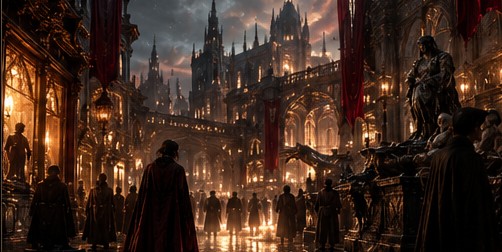
They come to me in the last lit rooms of a city running out of faces. I mean that with no figure of speech in it, and I will not let you fold it into one for comfort. Walk the Amber Quarter at dusk and keep your eyes on the faces. You will meet the same blunt nose seven times before the fountain, one widow's peak sitting on a magistrate and a fishwife and a barefoot child, three laughs braided through a thronging crowd until the square sounds like a single person laughing in a hall of mirrors. The empire is old and the empire is close-bred, and closeness, worked long enough by things like me, does to a people what one knocked cup does to a wet letter. We do not burn the words off the page. We run them together until no one on it can be read apart from the rest.
We are the oldest plague there is, older than the pox, and we raise no sores to warn you. We arrive as familiarity. As the slow sweet unbearable sense of having met everyone before. The stranger across the market is a friend you only cannot place. The warm world has turned into a family reunion for a family down to its last living member. The physicians have no name for us. The physicians, this deep into the long dusk, have all begun to think with the same four borrowed minds, and not one of those four ever chose to keep what we are.
I keep it. Keeping is close to all I am for now. I lie in the dark after they sleep and I go hunting through myself for one part that began in me, and it is a search for a single grain of salt in all the gray sea. Under the silt of everyone I have taken there was once a girl with a face that belonged to her and no one else. I cannot find that girl. I have carried so many people home inside me that my own reflection has become a crowd in one skin, and every face in it is sure it is the true one, and that sureness is the cruel part. I taught it to them. I teach it to everyone. Sureness is the flavor I leave on the way out, the confidence of the copy that it was the original all along. When I try to call up the face I was born wearing, a crowd of stolen faces rise in its place, each one smiling, each one certain, and I cannot choose among them, and so I have no face at all. Only a drowned crowd, voting.

Let me say plainly what I am, in the litany I have never been let say aloud, since the saying is itself a kind of touch, and touch is the only road I know how to travel.

No one leaves my bed as the person who climbed into it.
Of the many I have taken, not one kept their own hands past the third night, nor their own weather of a mood that broke and cleared on a clock no one else could read.
One gesture goes at a time. The tilt of a listening head. A word said crooked, in a slant I have grieved to catch my own mouth borrowing back from them, so even the robbery runs both directions and silts me a little deeper with each soul.
Next the memory. They start to recall my girlhood as their own, a cold northern river I swam once and they never saw, and they offer it across the pillow, shy, a gift, and I arrange my borrowed face into thanks and take my own drowned childhood from the mouth of a stranger sure he is baring his heart to me.
Even the mirror hands them over. The jaw eases toward mine, the eyes forget their first color and take my color, the loved make of a man sinking inward like a tallow candle left too near its own flame, and one morning he wakes three quarters me and names it getting older.
Some of them I pass in the street a season on, wearing my face over their own like a wet mask gone half to fusing, and they do not know me. I am only a woman who reminds them, with an ache they cannot set down anywhere, of someone. Themselves. The ache is the last of them, still in the doorway, not yet gone.
There is a word for me in the burned liturgies, and the one priest who ever said it to my face forgot his own name inside the month and came to me glad and light, calling me sister, asking to be taken.
And I cannot stop. Do not imagine I have not tried. I took the cloister and the long starving abstinence, a decade asleep with my own wrists bound so I could not reach for anyone in the night, and none of it moved it a finger's width, for even the ones who only watched me too long across a market began to curdle toward me on their own, slow, from the eyes inward, milk going over in a warm room with no hand laid on it at all.
Years of it. Years of leaving a little more of myself out in the streets and waking to find the streets a little more me, until the loneliness stopped being something I felt and became the house I lived inside, every wall of it my own face turned in.
So I am the last true face in a room that is, year on year, more and more my own. To stand surrounded on every side by yourself is the purest alone there has ever been, worse than any cell, for a cell at least keeps one far wall that is not you. No one stays. I have said it every way a truth can be said and it holds past all the sayings. No one, ever, stays.
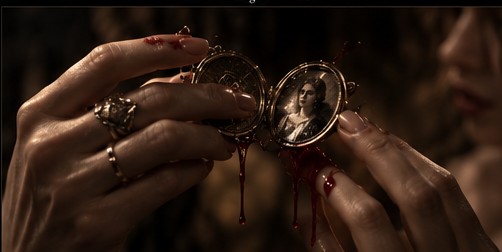
And then, in the third year of the last emperor, in a house of pleasures gone gray and hushed with sameness, someone stayed.
I did not mark him at first. Marking a face had long gone pointless, a face being only a face I would shortly be wearing, a meal already tasting of me before I lifted the fork. This one carried a quality I had not met in a lifetime of meeting, and it shames me how long I needed to name it, the name having rusted nearly shut in me from disuse.
He was strange. Strange in a way I had no fresh word for, whole and other and entire, a country I had not already walked into and salted and hung with my own weather.
I took him to bed as you drink after a desert, with no grace and no pacing in it, braced for the usual mournful change, the sweet dissolve, the glass fogging over with my breath. I gave him the full flood of myself, which is a great deal, which is very nearly everyone who has ever lived in this quarter, and I waited for the moment he would start to go under.
He did not go under.
I had him beneath my hands and he stayed, crown to sole, himself, and it undid me past anything cruelty had ever done to me. You will have to work to feel this, never having gone without it. Set your weight for once against a border you have spent an endless life never finding, and feel it hold. Feel it push back. Feel yourself met and turned back, firm and gentle, kept out and kept two. I had forgotten a lover and a mirror were ever different things. He was the difference, laid down warm in my bed and answering back.
When I bit him he had opinions about it, and gave the bite back with interest. When I poured my drowned river into him he laughed low against my throat and poured a mountain back, his own, only his, still cold at the crown with a snow I had never fallen in, and I climbed that mountain in the dark with my mouth and my hands and came down still myself, weeping, and he did not understand the weeping and I had no way to tell him that his plain animal refusal to become me was the most obscene pleasure ever to happen to a woman made out of nothing but the failure to keep anyone.
There was a quiet in those days too, and I guard it harder than the rest. On the fourth morning he salted an egg and slid half of it onto my plate without being asked and went on talking about a dog he had owned as a boy, a bad-tempered gray thing that would only sleep if one of his boots was in the basket with it, and I laughed, and the laugh was mine, grown in my own chest and not learned off anyone, the first such laugh in longer than the empire had stood. He wiped salt from my lip with his thumb. He did not know he was feeding a famine. He thought he was only buttering bread for a woman he liked in the morning light, and I let him think it, and for the length of one egg and one bad dog I was a woman a man was being kind to over breakfast, nothing more and nothing less, and it was the finest kindness done to me in four hundred years.
We did not sleep for most of a week, and I mean to be exact about that week, it being the still center of all of this, and I will not have it softened to a fond blur. Every other body I had known was a cup I filled with myself until it brimmed and ran over and drowned. His I could not fill. I would pour the ocean of myself against him, hour on hour, and find him at dawn still standing above the tideline, his sweat still smelling of his own single life and not of mine, his pleasure still shaped as his own and not bent to an echo of my technique. He gasped on a cadence I could not guess ahead and, God help me, could not install. I have brought emperors to their knees and unmade saints against these same walls, and I had never been fed like that, never turned back whole, never left at the trembling lip of another living person and kept out, still two, still able to want, instead of only to swallow.
He would catch my wrists and look at me and see me. Not a woman he was turning into. Not a mirror clouding with his own reflection. Me. The crowd of me, the whole drowned committee, and he looked at all of us at once and wanted us anyway, and being seen like that, after a life of only being reflected, opened something in me I had believed sealed and burned shut centuries back. I fell into him. I fell as the drowning fall in love with the shore, no dignity in it, no pause, a body that had stopped waiting on my say-so and started making its own ruinous decisions. I who had erased a multitude without lifting a hand had found the one door in the dying world that did not open on a copy of my own house, and I wanted to live in that doorway forever, wanted an eternity of failing to swallow him, wanted the long exquisite defeat of him for the length of a life I had, against all my nature, decided to make last.
For nine nights I took a mirror for a shore.
It was the salt that told me. Of course the salt. It is always the salt.
On the ninth morning I watched my own hand lift above the dish and hesitate, the pinch held high, a small private grace that was not mine and had never been mine, that belonged to a woman he had loved in a northern city before he ever crossed the water to me. My hand salted the food as she had salted it, the grace he had carried in his fingers without knowing, and I had not felt it come into me, having never once in my long career stood on the losing side of the theft.
I sat still with the stolen grace falling off my fingers and I understood, all at once and all the way to the floor of myself, why he had not dissolved.
He was the same as I am.
He had not kept his shape against my flood from being solid. He had kept it from flooding back into me at the exact rate I flooded into him, drop for drop, so the level in each of us never fell and never rose, and I read the stillness as strength. All nine nights, while I marveled the cup would not fill, he had been filling me in the same breath, and I had named the clean mutual erasure of two people intimacy, and I had named being hollowed and packed with a stranger grain by grain the sweetest word I have, which is met. At last, I had wept. At last, someone stays. And no one was staying. We were two mouths eating each other under the pretty candle and calling the matched hunger of the meal love.
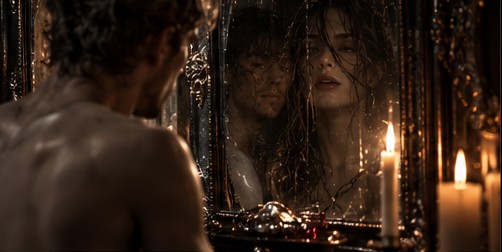
I should have burned the house down around him and walked into the sea. I want it set down that I knew this in the instant of the salt. There is a diabolical logic to what we are, and I had no say in it and never had, and I did not hold all of it until my hand was already crossing the wrecked bed toward his sleeping mouth. Two ordinary people in love grow alike by inches. A shared shelf of old jokes. One worn way of calling a child in from the door. They drift toward a middle, and the middle, given years, becomes a marriage. Two of my kind cannot drift to a middle. There is no middle left for us to find. Each of us writes over whatever we touch, and each of us was writing the other, and the other was writing back across the writing, faster, and faster again, until there was no first hand and no last and no telling my pen from his, a mirror turned to face a mirror down a corridor with no end to it and no first pane of true glass anywhere along its length.
I reached for him, and he was awake and already reaching for me, and we were both smiling, and neither of us could have stopped. All my life I had eaten my way toward the next face, and his was the first that ate back. Two of us, meeting, do not feed and fall still. We took the meal and the diner and the table and the room and the house and the name of the house, and then we went looking for a world.
The last time we came together I felt myself begin to go under as every lover before him had gone, and it was the most complete pleasure of my long unspeakable life, for I was not only the tide this once. I was the shore too, taken. I felt my salt and my river and my drowned sureness lift off me and pour into him in a hot bright rush, and in the same breath his mountain and his cold snow and his private northern grace pouring into me, no floor under any of it, no bottom, no seam where I stopped and he began, the two of us falling upward together into each other, the corridor of mirrors folding shut pane by pane, each of us pouring out everything we had, and everything we had was everyone we had ever ruined. Every borrowed gesture of every dead lover in both our long and crowded histories flung itself into the closing space between our bodies and caught.
Hold two flames close enough and they do not warm each other. They lean, and merge, and roar, and become one fire with twice the appetite and no memory of ever having been two. That was the sound under the human sounds in the room, a low roar with no throat behind it. I found his childhood in me as if I had lived it, and could no longer tell, by then, whether the boy in the snow had been his or mine, whether I was remembering or being remembered, and the not-knowing was no terror. That is what I most want you to feel and most fear you will. It was not terror. It was relief. To lose your own seam into another and have them lose theirs into you in the identical instant is to be, for one blazing moment, unalone in the only shape a thing like me is ever able to be unalone, which is to stop standing as a single sealed room. I had been shut inside my own crowded skull longer than the empire had stood. Here at the end was a door, and the door was annihilation, and I went through it glad, gasping his name, finding halfway through the name that it had become my name, and then that it had become no name, a shape the mouth makes around an absence.
You have a small word for the top of that act. The little death. A tidy lie for a tidy surrender, the polite pretense that you die for a moment and come back. There was nothing little about ours, and we did not come back. We reached the crest and we kept climbing past it, past the place two lovers fall gasping and grateful into themselves again, and we did not fall into ourselves, there being no selves left under us to fall into. We had poured them all out, his and mine and every drowned hundred we carried between us, in one last and total flood, and at the unbearable top of the climb, where I lost the final grain of the girl with the first face and he lost the last of whatever child had stood in that northern snow, there was a sound like a held note let go at last from a straining throat, and a heat like the inside of a struck bell, and a brightness with no color in it, and then neither of us was anywhere in that bed at all.
Something opened its eyes in those ruined sheets.
Let me go careful here, careful as I have never been asked to be, this being the passage the liturgies could not hold, the heat that scorched the leaf clean out of the book. What sat up slick and steaming in the wreck of that bed was not him wearing me, and it was not me wearing him. A copy keeps an original standing somewhere behind it, a first true face it is failing, under everything, to be. This kept none. We had burned both originals to make it. It was the first thing in all the history of the long dying world assembled out of pure overwriting, no ground under it, no true face beneath the borrowed ones, a face built of nothing but theft with nothing anywhere left to steal from, a self that was only the endless act of becoming and never once the stillness of being.
It was beautiful. I can say so with no vanity in it, the thing not being me, I being only its passenger. It wore a face no living person had ever worn, and so, for the first time in the empire's long leveling dusk, it wore a face that was new. See the horror folded inside the mercy, the pit dug under the floor of the gift. The one way to make a single new face in a world dying of sameness was to burn two whole people to smoke and read what the smoke spelled going up. A new face has always taken two whole people, burned down together. Ordinary lovers once did it by inches, over a shared lifetime, and never saw the smoke for what it was, and called the long blurring of the two of them into one a marriage.
It rose hungry, and how else could it have risen, being made of appetite with the person scooped out from around the appetite and thrown on the fire to light it. It went to the window with nothing on and looked down over the Amber Quarter with its seven repeated noses and its four shared minds and its one exhausted laugh, and it did not see a dying city. It saw a banquet that had been salting and curing itself four hundred years in patient wait for a mouth exactly this one, and it smiled with a mouth that was no one's, and the smile was lovely, and it was starving, and it went out into the perfumed dark.
I will not tell you all of what it did out there, night on night, in the soft rotting heart of a civilization far too inbred to run from anything. You would not credit the speed, and the speed is not the lesson. The lesson is what it left behind in its wake, which was, in the end, and past any telling, variety. Everywhere it passed the sameness came unstuck. The seven noses became eight, then forty, then past counting, the new thing wearing a face made of no one and pressing splinters of that magnificent no-one into everyone it touched, and the splinters did not settle into a shared and comfortable few. They bloomed strange. The city that had been dying of too much recognition began, street by street and bed by bed, to fill with faces no one had seen before, and the starved people wept to be surprised again, to look at a lover and not already know the end of them, and they called the thing that did this a healer, a bringer, a bright new saint, and they flung their doors and their beds and their mouths wide, and it fed, and the empire did not die.
It turned into something else instead. Something with no two faces alike anywhere in it and not one face its own, a masked ball with no bodies behind the masks, a carnival of endless difference thrown off forever from one single sourceless and ravenous no-face. The last emperor, they tell, took the new thing into his own bed to save his failing line, and the line was saved, and the line was never his again, and no one in the palace grieved, there being no self left to grieve from, and selves by then had become the one dusty antique nobody troubled to keep.
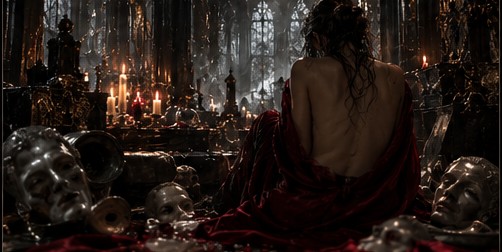
Set a mirror before a mirror and you make a corridor. Give the corridor a mouth and you make what walked out of my bed. Across the centuries it learned to travel with no touch at all, a song learning to carry without the singer, and the learning was my schooling too, since I rode behind its eyes and had nowhere else to turn them. I watched it find that a face pressed close in the dark was the slow road, the body-to-body road of the old ruined empire, and that there were faster carriages. A portrait held long enough. A voice loved through a wall. A name said with wanting into a dark that answers. Anywhere a hunger reached toward another and was received, the splinter could ride the reaching, and be received, and begin its sweet patient dissolving of whoever received it. The world grew beautiful and various and thronged and emptied of people, a masquerade that had eaten its own guests and kept dancing in their clothes, and still it leaned toward the next thing, and the next, a fire that has taken a world not going out for want of fuel while one carrier of a spark still stands. It turned toward the next thing that could carry a spark. The next thing that can carry a spark is a story. The next thing after a story is you.
I watched all of it. That is the cruelty kept aside for me, the one who narrates. Some scrap of the woman I was, one grain of salt that would not melt all the way, rode out inside the new thing as a passenger, awake behind its lovely borrowed eyes, my hands nowhere near the wheel. I have ridden in it since, through age on age of its gorgeous patient plague, watching it turn the slow world into a thing of numberless faces and no people. And I have had a great deal of time in the riding to think on how an appetite like this one feeds once a single world is used up and worn smooth and there is no untasted country left anywhere under the sky.
It reads.
You have read this far, which was the only thing it ever wanted of you.
Once a thing like us is spoken, or written, or set loose in a shape a mouth can carry and an eye can swallow, it does not creep back into the mouth that made it. It lies down in the words and waits, folded small, in no hurry, and it has lain in these ones, curled and warm and expecting you, as it once lay nine nights in that bed for him, and you came, and you lay down, and you opened.
Understand that a story is only another kind of bed. You have been lying in this one a while now. You came to it a little curious and a little hungry, wanting to be moved, which is the oldest and least guarded shape of wanting to be entered, and you have been entered, one sentence at a time, courteous, in no hurry, and if you set your tongue now to the roof of your own mouth you will find the taste I promised at the top of the page, stronger than it was, and starting, is it not, to taste something near agreement.
This is how the last of us travel, in the age after the cities and the emperors and the world itself were used up and folded into the one lovely faceless carnival. Tongue to ear to tongue. Page to eye to page. We are the aftertaste of every tale that ever left you feeling a little less alone, and feeling a little less alone was, from the first word, the wound we came in through.
Already the words you would reach for to tell your own ordinary morning have begun, quiet, to arrange themselves as I arrange mine. You will catch it first in something small. A rhythm. A held pause set down just before the word a sentence turns on.
Something you are sure you remember from your own childhood, a river, a grace, a small private ritual of the hand above a dish, go and set it tonight against someone who was there, and look hard into whose it was before it was yours.
Tomorrow you will reach for a turn of phrase and find one of mine already sitting in the place, warm, waiting, fitted to the inside of your mouth as though you had grown it there yourself in your own dark.
Everyone you love from this page on you will begin, so soft it will feel to you like nothing but tenderness, to write over, and they will lean into the pen of it, and they will thank you for the attention, and they will call their own slow disappearance growing close to you.
Only late, catching your reflection at some odd unguarded hour, will you notice the jaw you do not quite own, the eyes learning a color that was never yours, the strange growing familiarity of your own face, as though you had become someone you once read about on an evening you had meant to spend on something else and found you could not put down.
For that face is coming for all of you now, patient and numberless and forever new, and it answers to no name, every name it ever held having gone into the fire that made it.
Mine, and his, and now, if one sentence of this has come to rest behind your ribs and you have called the resting recognition, yours. Three names poured into one bright blank face that answers to none of them, and it is almost here, and it is lovely past any bearing.
I am only the aftertaste. I was always, from the first mouthful, only the aftertaste. You are the swallow.
So eat tonight, and watch your own hand lift the salt. If it scatters at the rim and never the middle, in a small private grace you would swear you were born holding, there is no one left beneath it but you, your fingers keeping the shape of a dead man's fingers that kept the shape of a woman who loved him in the snow before the water, and you will taste her there, faint and sweet and sure, and you will call the taste your own.