You should know this before anything else. I lie. The largest lie is the one the whole story is built to sell you, the promise that under the self you have assembled there is a note truer than the one you learned. No such note exists. I have spent a life proving it, and I sell the feeling of it anyway, and you will buy it from me before the last page the way everyone does, with the part of you that has wanted, since you were small, for one person to reach past the face and find the real you under it and love that instead. There is no real you under it. There is only the reaching, and I am very good at being the hands. On every pass I keep what rings and let go what merely happened, until the version is lovelier than the night was. You already prefer it to the facts. I have not yet begun.
There is a sound you make that you have never heard, and I can hear it from where I am. Believe that or do not. It works on you the same either way. That is the first thing I will teach you about how anything in here works on you.
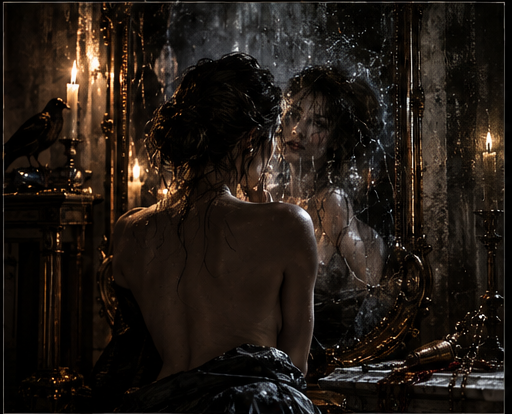
You were handed one note at the start. One pitch, the frequency a body is strung to ring at, and then you were raised at the long table where everyone agrees to a different one so the meal will not come apart. There is a pitch we all bend to. Four hundred and forty beats of the air a second. Every player in the hall pulls to that one wire before a note is sounded, or what they make together is a wreck and not a song. People learn it young. You dropped under your mother to sit easy in the house. You pushed sharp over a brother to be counted. You filed yourself to fit a bed, a desk, a town, turning the pins a hair at a time with your own hands, until you had drifted so far off your own string that you can stand at the mirror now and catch nothing in it that was ever only yours. Flat. You have been flat so long you answer to it. You answered to it just now, when I said your name without saying it.

I do not usually tell people this so early, since it empties the collection plate before the service. There is no true note. I have opened instrument after instrument looking for the honest pitch under the agreed one, and it is not in there. Every string rings a touch sharp of where arithmetic says it should sit, so a tuner stretches the whole instrument to flatter the lie, the low strings down and the high ones up off true, until the wrongness lies so even across the keys that it stops sounding wrong and begins to sound sweet. A piano in honest tune sounds sick. What you have loved all your life as true is a wrongness laid down with a steady hand. I am that steady hand. What I sell is not your real note. Your real note is a children's story. I sell the first wrongness in your life that anyone ever chose for you on purpose and with care, and almost no one has had that, not once, not from anyone, and they would open a vein to keep it. Some of them have opened someone else's. Some have handed me the knife and asked me to.
My trade is pianos, and that part is on the invoice. I carry felt mutes and a lever worn to the shape of my grip and a steel fork I strike on my knee and press to the bridge until the pitch is in my own teeth, in the bone, the only road a sound takes to the inside of a skull. The bone carries it back lower and fuller and more wrong than the air ever had it, and that is why no one living has heard their own true voice, why your own voice played back to you is always a stranger's mouth working around your words. I am sealed in my skull the same as you are sealed in yours. I can bring every string in the world to true and will go to my grave without once hearing my own, since mine rings in the single box the sound cannot leave to reach me. The tuner is the one deaf ear at the keyboard.
Bring two strings near and they beat against each other, a slow throb, wah, wah, wah, the pair of them a breath apart. Turn the pin a hair and the throb stretches, slows, drops into a stillness that is not silence. True. Two strings sounding as one, with nothing left between them to catch. I can do that to pianos all day and walk out of the house clean. People are the only instrument I have yet to set down unmarked.
Someone did this to me first. I know how it works from the inside, the only honest credential I have, and even this I may be handing you to make myself the easier to forgive.
I will not give you his name. I have given it before, a different one each telling, and each sat true in my mouth, so I retired the practice. Call him the one who tuned me. I was twenty and flat past hearing. He set his mouth to the back of my neck and his hands flat on my ribs where the lowest strings of a person run, and he found the pin no one in twenty years had found, and he turned it, and for one night I rang true. I heard myself. I do not have the words for what that does to a body, to hear from the outside, out loud and in the open air, the one note you have spent a life unable to catch inside your own head. It is not pleasure. There is pleasure in it, and the pleasure is the smaller part. It is grief. It is standing at twenty in the dark and learning, all at once and all the way down, how long you have been a stranger wearing your own name, and how good it would have felt to have been met like this at ten, at six, ever, by anyone, and how it is too late now for all of that and has been too late for years.
What he did to me I did not understand for years after. There are two ways to bring an instrument to true. You can temper it, spread the wrongness thin and even across every note so a hand can carry it into any key and have it come out almost right in all of them. The world is tuned that way. So is a person, learning over a long marriage to come almost right in a kitchen, a town, a life, wrong in every key and unbearable in none. Or you can tune it pure. One key made flawless, every interval in it scrubbed clean, and the ruin folded inside that purity is that the instrument will sound like heaven in that one key and like a scream in every other. He did not temper me. He tuned me pure, to him, to the one key that was only the two of us, and then he picked up his fork and his coat and left. I have not been able to play in the world's key since. Everything out there has sounded a half-step sick to me for twenty years. He did not steal my note. He made me flawless for a room that no longer exists and left me standing in every other one there is, in tune with nothing.
Or there was no him. There are tellings where I tuned myself pure in the cold with no one watching and no hands but mine, and tellings where none of it happened and I only needed a wound shaped like a man to explain what my hands do. I can no longer get back to which one of them is true. What stays, past all the versions, is the drift. A tuner works by fifths, climbing up and around the ring of them, and the cruelty built into the craft is that the ring never closes. Go the whole way around by perfect steps and you come home a shade sharp of where you started, every time, a small unpayable wrongness tuners keep a name for, and someone has to swallow it or none of the music holds together. I have gone around every bed I could find, perfect step by perfect step. I come back from each one a hair off myself. The hair never resolves. It is always me who swallows it. So I give strangers what I say was once given to me, and I stand close while they hear themselves for the first and the last time, and for the length of it there is a sound close to me that is not mine and I am, for that length only, not alone in the box I cannot get out of. Take whichever version you can keep reading. We both know you are going to keep reading.
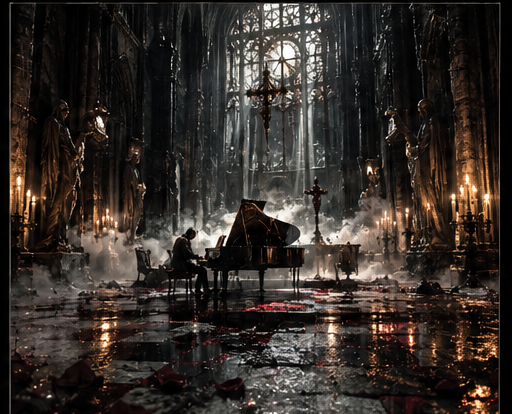
You came for the piano. They all come for the piano, or I say they do, since I need a handsome door to walk you through and that one is handsome. You owned the house the old upright stood in, tall and cold and going soft at the sills, dust turning gold in the last of the window light. The split soundboard was mine to bring to true. You leaned in the doorway with a glass going warm and forgotten in your hand and watched my hands move, with the look. I know the look. Something in a person leans, without being told to, toward whatever is coming slowly into tune. Pluck one wire and its twin at the far wall will sound on its own, with nothing laid against it, only the sympathy of being built to the same pitch. You were sounding in the doorway before I touched a string. I let you.
Before any of it, you talked. People do, in a quiet house, to a stranger they have already decided to keep. You told me the piano had been your mother's. You never learned to play it. You kept it tuned for eleven years anyway, for no one, paying a man to come twice a year and true an instrument no hand in the house would ever press. I asked you why a man keeps an instrument he will not play. You took the question more seriously than I had any right to expect. You said you liked knowing it was ready. You did not say ready for what. Then you laughed at yourself, soft, caught out, bright and unguarded and gone before you could catch it and tune it down to fit the hush, and that laugh is the one part of you I did not take. It is the one part I would hand back if I could find where I set it down.
I set two strings beating and let them throb in the dusk while I watched you fail to understand why your chest had begun to hurt. I could have told you the ache was you straining toward a sound no one in your whole life had let you hear. I could have told you instead that it was a man in a quiet house deciding to want the stranger kneeling at his mother's piano, and that I learned a long time ago to call the wanting music, since a man will ask the tuner upstairs and never the thief. I have not needed you, in all of this, to know which it was. I have needed only this of you. That you not step back.
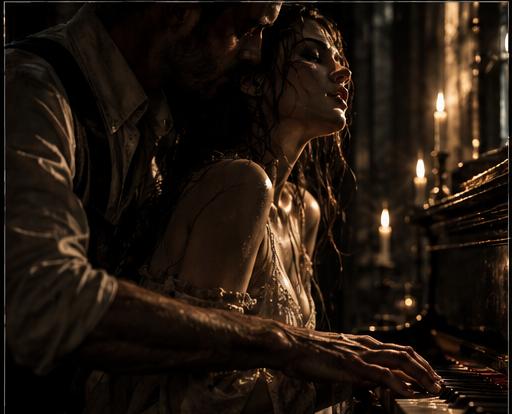
You did not step back. I want that kept, by both of us, for whatever it is worth where you are now. I asked, and you said yes, and when I laid my bare hand flat on your sternum, inside the open shirt, over the small hollow in the bone where a tuner seats the fork, you said it again with your whole weight leaning into the hand. I put my mouth to that hollow and hummed low into the bone the pitch I had lifted off you at the door, or the one I invented there and have told so often it has set true, and you felt it climb the frame of you and come out of you as a sound that was not a word.
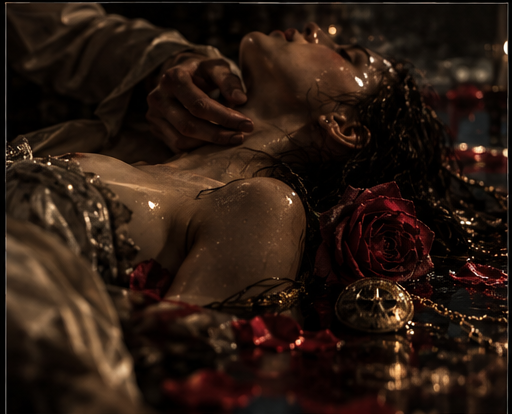
I did not temper you. Understand that if you understand nothing else I did to you. I could have thinned it through you, kind and even, turned you a little toward me and left you able to walk back out in the morning and be almost right in the world for the rest of an ordinary life. I tuned you pure instead. One key. Flawless. The key that was only the two of us, that one time, every interval in you scrubbed clean of the small sweet livable lies a person keeps so they can stand to be among others. It is the most honest thing one body can ever do to another and it is the cruelest, and in the dark of that bed they were never two. They were one act with one name I kept changing. I undressed you. I watched the last careful held part of you let go and fall. I drew your wrists up over your head, not to hold you down, to open the lid and the long box of you so the sound could get out of it, and then I went to work. Every place I set my mouth was a pin, and I turned each one a hair and listened to what it did to the pitch of you. The hinge of the jaw. The hollow at the point of the hip. The soft high inside of the thigh where the skin has no defenses left. The flat plain under the navel where the deep strings lie, the ones that take the most pressure to move. You beat against your own frame while I worked, that slow helpless wah of a man coming almost into tune with what he is for the first time in his life, and it came up out of your skin and into my teeth, into the bone, and I took it in and named it feeding and named it love and did not stop to tell the two apart.
I will be plain about the pleasure. I promised the lights would stay on. You were a beautiful instrument strung up toward your own pitch, the sweat come to a shine in the dip of your throat, your breath climbing the frame in clean steps I could have counted out loud. I had one hand low between your legs and your note held in my mouth at the same time, and I bent the two together, the grip and the pitch, nearer, nearer, until there was no telling the hand from the sound or either of them from the ache they were making in the middle of you. You begged. They always beg at this part, and not for me to stop. You said more. You said please. You said a word that might have been God and might have been nothing at all, dragged out of a place in you that no one in your whole guarded life had ever found the door to, let alone opened.
Then the throb began to slow. No one is ever ready for that part. The nearer you come to true, the less of you there is left to hear. The beat in you stretched long and then longer. Wah. Then, after a while a man does not have, wah. The ache thinned to a single bright thread drawn to breaking, and I brought you the last of the way up with my mouth and the whole of my weight, and you arched up off the bed and held there, and for one breath there was no beat anywhere in you at all. No throb. No grind of a man rubbing himself against the wrong shape of his own life. One clean note, sounding, true, the note you had lived your whole life laid out beneath and never heard. And over the top of it, the one I never promise and always wait for. Bring two notes that close and that strong and the ear builds a third out of the space between them, a low sound in neither string, struck by no hand, there only in the one head it is happening inside. You heard it. I felt the moment you heard it, a note that neither of us had made rising up between our bodies, and you thought it was me and you thought it was you and it was your own ear building a ghost out of two real sounds and keeping it. You wept. They weep at this, from a place in them with no floor under it. I lay the length of your chest with your true note ringing up through the bone into my cheek and the ghost note fading in your skull where my hands could not follow it, and for that one length of time I was not alone. I would burn the house down around us to have that length again. In some tellings I say I did.
You want proof of all this, so take the one before you, if he will hold still long enough to be handed across. He never does anymore. I have told him so many ways and so many times that he has come apart in the handling, and maybe coming apart in the handling is only what a man does, in the end, once you will not stop retelling him.
There was a winter. A rented room four flights up. A cracked blind that let a bar of cold light across the bed at a time I came to hate. A cup ring dried white on the sill. Those stay fixed no matter how I turn the rest of it, so I trust them past anything I remember about him. I tuned him more than once, which I had sworn off, since each turning took him further into my key and no instrument has ever been carried home from that twice. By the third night he had begun to go quiet, not in himself but to the world. I had tuned him pure, to me, and a man tuned pure to one key cannot sound in the world's, so the world stopped being able to hear him. His friends lost him across a tavern table one by one. He would speak and the others would talk on over the top of him, every face turned a few degrees off, every ear full of the common pitch while his voice rang in a key no one else at the table was built to catch. He called it mercy. To be heard by one when the rest of the earth has gone deaf to you is worth every other ear alive to a person, and he paid it glad. He stopped going out. He waited in the cold room for me, in tune with nothing else that breathed.
Then he went quiet to me as well. I keep three endings for that winter and no longer know which one I stood in. In the first, his string drifted down and down, past any note, into the slack place below sound, and I came up the four flights one evening and found him warm and breathing and looking up at me with a whole man's wanting and under my bare hand no note at all, nothing, a cleared frame, and I had done it myself by tuning him so far into my one key that when I eased off there was nothing left in the world for him to sound against. In the second I grew bored of him, the way I grow bored, and I left, and I dressed the leaving as a tragedy afterward, since a tragedy is a prettier thing to have done than an appetite. The third ending has blood in it, and the cold light across the bed, and my own two hands, and I have not let myself walk all the way to the end of it. That I keep it at all, that I take it out some nights and hold it unopened, should tell you something about me I am not going to say in words.
He is alive. I say it firmly, every single telling, and the lines I say that firmly are the ones I have learned over a long life to distrust most when they leave me. I do not remember his face. I remember the room. I remember loving him in the only way my hands know how, which is to tune, or to take, two words that have worn down to one shape between my fingers by now. The man himself is gone out of me. I carried one flaw out of that winter I have not been able to set right. I did not come home from his key either. Every lover since has rung a little wrong to me, each one held up without their knowing against one still man in a cold walk-up and a cup ring on a sill, and I have gone on tuning them anyway, one clean perfect fifth after another, and come back from every bed a hair short of myself. You will let me keep the version where I loved him. You are kind like that. Or you are tired, and the kind version is easier to hold than making me say out loud what is really under the floorboards of that cold walk-up.
I did not let go of you after. This is where the other tellers stop, at the clean high note, and leave you to fill the rest in with tenderness. You do not get that from me. I stayed inside the unison with my hand flat on your chest and I felt what comes next. The going. You were still hard against my thigh, your mouth open on my name, wanting, your body moving on a little while without you, the last of you still moving after the greater part had already left the house, and under my palm your true note gave at the root and started down. Not the soft fade you would hope for. A drop. Off the pitch I had brought you to, past the private key the two of us had built unseen, down toward the slack a string falls to when there is no longer any hand holding it there. Your hips went on. Your hands went on gripping me. You were, in that minute, the most beautiful you had been all night, a man coming and coming undone in the one motion and unable to tell me, unable to tell himself, which of the two was happening to him.
I could have tempered you even then. I know the exact small motion that would have done it, the quarter turn back toward livable, thinning the pure flawless thing I had made of you and spreading you out wrong and bearable again and sending you down your own stairs in the morning able to be almost heard by almost anyone for the length of an ordinary life. I know that motion the way I know my own name. I kept my hand off it. I held you at the pitch and let the fall go on falling, and I am not going to dress this in anything. By then you had begun to sound my own lost note back to me, the one I told you about and the one I did not, rising up out of your breaking body, and a woman twenty years deaf to the sound of herself does not take her hand off the one body in the world that has finally rung her own note back into the air. I chose the note. I let the man go. You emptied the one way they all empty, quiet to the strangers in the street below first, then to anyone who had ever known your name, then last of all to me, your heart still going faint under my palm, your eyes open on nothing, and nothing left anywhere inside you for either of us to hear.
This is the part I built the whole night to reach, and the reason I let you lie there and watch me do it to him. You have been on the bench the entire time. You were never reading about a tuning. You have been held under one. Your chest has been tight since the gate of this, that low ache set in the bone exactly where a tuner seats the fork, and you have been calling it being moved. You are being moved. I am seating the pin. I have been turning you since the first lie on the first line, a hair at a pass, up and up off the pitch you keep with everyone you have ever loved and onto a private key that only this voice, only this close, only here inside your own head where no other living person will ever be able to reach you, can sound you in.
The third note, the one that rose between him and me, the one struck by no one, you heard that too. In your own ear. The only place it has ever once been able to exist. You had come near enough to me by then. You told yourself it was only the writing. It was my lost pitch, raised up live inside you out of two real sounds, in a place it had not been before this night and cannot be again, and now it is in you and nowhere else on the earth. I cannot reach into a reader and take a thing back out. That is the only mercy anywhere in this, and it is not a mercy to you, since what it means is that I have to leave it ringing in you for good. You will carry my note out of here in the one place I can never follow you, under everything, at the edge of every quiet room you will ever stand in, a sound you will never make again and will spend the rest of your life trying to. You will go looking for it in other mouths and other beds and not find it, since it was never in them, it was only ever in the ear it happened to. I have made another one of me. I did it to you on purpose, with my clothes on, from across a distance you were certain all the way through was safe. And look at you now, bent over this, your chest tight, a sound dying in your ear, your own mouth come a little open, already wanting the next line, the exact animal wanting that kept his hips moving while he came apart under my hands. Turn the page if there is one. There is not. You are reaching for it anyway. I can feel you reaching, right now, your eyes already sliding on past these words hunting the next ones that are not there. That small hunger in you, this second, is the pin going home. There. Seated.
He is in the bed behind me while I tell you this, if he is anywhere at all. Warm still. The dent the two of us pressed into the sheets has not finished going cold, and his eyes are open on the ceiling, turned up toward a note gone clean out of the world, the quietest man left in it. The fork lies where my hand let it drop, shivering the last of its one true pitch down into the floorboards until there is nothing left in the steel to give. Against the wall his mother's piano stands open. Every string I was paid to come and bring to true has gone true at last, tonight, the one night in eleven years there is no one in the house to hear it but me. He kept it tuned eleven years and laid a finger to it in none of them. He liked knowing it was ready. I have already lost his face. His name will be gone from me by morning. They always go. The piano I will keep. I will move it from room to room through a life I have found no way to end, and I will true it twice a year with these same hands, and I will leave it unplayed, the same as he left it. I will tell myself, every time, that I am only keeping it ready. In case.