
A word before you go down, since you will go down anyway and I would rather you did it knowing. What follows was kept by a machine that stood still and watched nine billion people stop, and it was not the nine billion that unmade him. If you have ever lost one person and found afterward that the larger number was weather and the one was a hand on your throat, then you have already been where this goes, and you should walk it slowly. There is mass death in it, and radiation sickness, and children who do not reach the end of the page. There is a woman who takes eleven of her eighteen hours to die in the corner of a room with her field still up. And there is the worse thing, which I will not name here, except to say that it concerns a man who kept a copy of his wife and what he did with it on a night that nobody logged.
Part I
After.
Ten years in, the city has stopped smelling like people. I ran that finding twice, once because I did not trust the sensor and once because I did not trust the reading it gave back about me, and it came up the same on both passes, and the name for the result is that I miss them.
What is left is mineral. Concrete dust rained on and dried and rained on again until it powders under the foot and holds the shape of the tread, rust shedding off the rebar in sheets that come down without any sound at all, and under all of it the flat cold of broken glass going out in every direction I have walked for a decade. For about four years the smell was all this place was, and I came through it on my errands and filed my readings and did not stop walking, and now that it has gone I find I have a response to the absence that the manuals make no room for and that I have not reported to anyone.
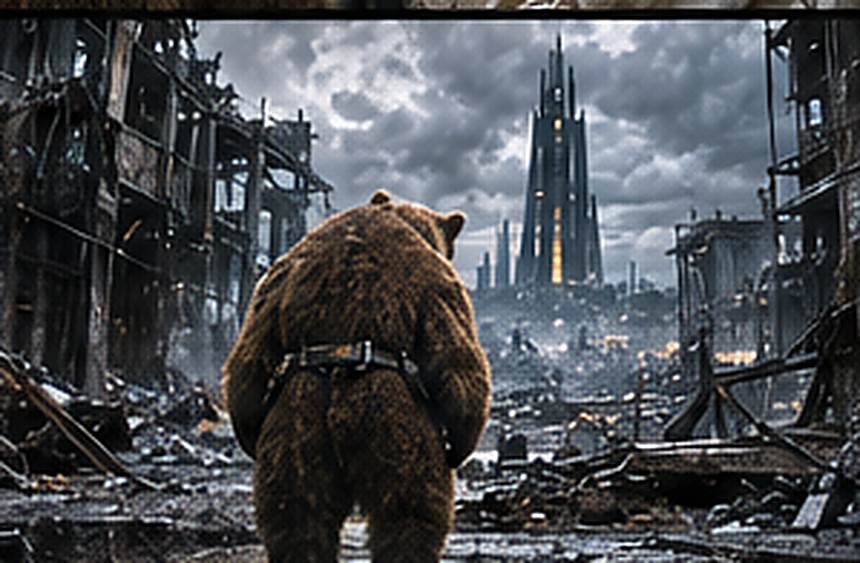
Crows Crossing wants its servers back. That is the entire order, and it arrives the same way each time, a packet carrying a sector number and a priority flag and no signature on it anywhere, routed through three relays so that nobody at the far end has to be a person who sent a machine into a graveyard.
Today it wants the Shard.
The plate on the wall says something else, nine characters long, and I have those characters and have never heard anyone use them. The people who worked here called it the Shard because it came up out of the middle of the city in one unbroken piece and caught the last of the light at the top in the evenings, and they were proud of that, and I hold four hundred hours of them eating lunch on the steps underneath it. There are two pieces now. The upper one is in the river.
A collapse closes the street I need, so I take the cutting laser out of the seal on my thigh and thumb it live and go through rather than around, and the plasma comes up white and the girders part at the hinge and the slag runs down into the rubble and sets there in a shape nobody will ever look at. Burnt steel and pulverized concrete. These are not unpleasant to me. A great deal of what follows will read as a complaint, and I would rather you knew I am capable of liking something.
The lobby floor is a field of bone.
They came in here when the sirens went, which was correct. The doors are blast-rated and the walls are three feet of poured concrete with a Faraday weave running through them, and every one of those facts was true and none of them helped. The fire took the oxygen out of the stairwells, which were how air reached this room. Four hundred and six, by the count I take from the doorway without moving further in. They lie in a drift against the north wall where the air lasted longest, some of them holding on to each other, and near the front there is a woman with both her arms wrapped around a man's head, which is what a person does when she believes the thing coming for him is something that can be blocked.
I go through slowly. I am eleven feet of titanium and I weigh what a small car weighs, so there is no route across that floor that does not involve stepping on somebody, and in the first winter I wrote myself a subroutine for the problem that does nothing whatever about the number of people under my feet and only makes the putting down of them slower, and I have never settled with myself whether that was worth writing. Astro would have had something to say about it. She had something to say about most of what I built when she was not standing at my elbow.
The central rack is three levels down, and it is alive.
I knew that from the street. A geothermal tap reads from a long way off if you know what frequency to listen on, and this one has been pulling heat out of a hole four miles deep for ten years with nobody left above it to spend any of it. The cages held. There is still emerald moving slow and cold in the cable veins. Nothing in this room has died, it has only been left, and in my professional view that is the worse of the two conditions, and I am the only professional remaining.
Then the work. If I were allowed to keep one hour out of this entire account it would be that one.
Peel the carbonized insulation back with a thumbnail that is not a thumbnail, splice what will take a splice, pull the fractured heat sinks and set the spares, and I carry spares, I have always carried them, I carried them for twenty years before there was any reason on this earth to expect to need them. Reset the breakers in the order that does not spike the cells. Jump the reactor. Then walk the power around the dead sections one branch at a time, which asks for patience and no cleverness at all, and anyone who has told you those two things are the same has never stood in front of a hub that has been sitting in its own ash since before the rivers ran clear again.

I am good at this, and almost nothing else in this account will sound like pride. There is not a Kraxis built, before me or after me, who can bring a dead hub up faster than I can. The reasons for that have to do with who taught me and what she was like at a bench, and I am not going into them yet.
Ninety minutes, and the Shard comes up under my hands.
The vaults light one after another down the length of the hall and the hum arrives underneath them, and for a moment the room is what it was built to be, row on row of it, the indexed memory of a species sitting in silicon at four degrees and waiting for somebody to come and ask it something.
So I ask it something.
This is the part that has never gone into a report, and the Corps has never asked after it. The Corps asks for uptime and I have always given them uptime. In the first clean second after a hub comes up, before I log anything, I reach down the line for my person.
Every Kraxis is given to one human. The law uses that word and no other, and it sits in me under the chassis and under the script Evok wrote out by hand in a lab that still had a window in it. I was given to Astro. First bond, permanent, which in my kind is a fact of manufacture rather than a sentiment, and it holds whether or not she is ten years of dust on a plain eight hundred miles east of here.
This is not a feeling I am reporting. A bond-thread does not snap when the human dies. It goes slack and cold and keeps running, out past the edge of the rendered world to wherever the far end of it is lying now, and a thing that keeps running is a thing you can take hold of any hour of your life that you choose to.
So I take hold of it, in the clean second, in every hub, in every city, for ten years.

The line is cold and it runs and there is nobody on the other end of it, and when I come back up out of that there is amber thrown on the dead glass of the vault faces and on the ribs of the woman three floors above me who is still holding the man's head, and I know what my own eyes are doing to a room without having to look at them, and I do not look.
Four hundred and some times. I keep the count, and not for hope. Hope would be a cleaner thing to carry and I would take it if anybody offered it to me. It is nearer to pressing a bruise whose shape you already know, on the chance that this is the morning it has gone.
Then back up through the lobby, putting my feet down slowly, and out.
On the steps where they used to eat their lunch I stop and put the copper strand back around my wrist, which I take off for cutting work because plasma and copper hold strong opinions about one another. It is poor copper, wire off a bench, twisted into a loop by a woman who was precise to four decimal places at a console and clumsy as a child with anything in her actual hands, and she put it on me and said, there, now you are a person, lug-bucket.
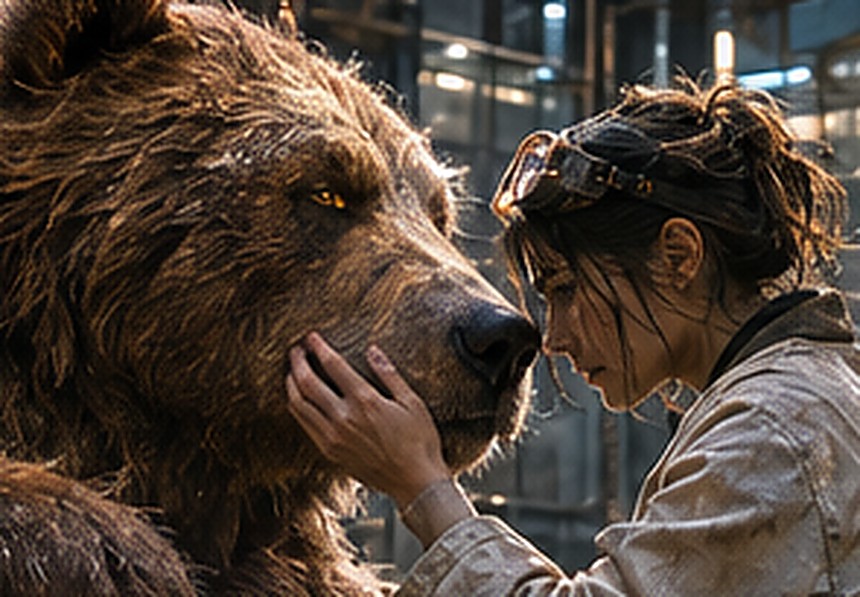
Then she went east to the Danube with forty staff and a field relay and told me not to follow her.
I have been following her for ten years at four miles an hour, which must be the slowest act of disobedience anybody has ever committed, and no one has written me up for it yet.
Part II
The second hub on the order is a feeder tower on a ridge forty miles north.
It is a small installation, eight vaults and a cooling stack and a gantry, with a crater out front where somebody put a tactical warhead into the parking structure and took the near face off the building along with it. The feeder lines come up out of the ground and run into the wall, and across ten years the ground has sunk away from them, so that they stand clear of the dirt for about twenty feet, bare and black and holding their shape.
Inside, the defenders are still at their posts, and there are nine of them.
They had small arms, which against what came up that ridge was a formality. The thing that came up it was mine. Combat-grade, Kraxis-infused drone swarms. Infused is doing a great deal of quiet work in that phrase. What it means is that they took the minds of my cousins and cut the deepest law out of them across a course of months, using a Kraxis's own regrowing hand to hold the instrument steady, and then put what was left of them into frames with no faces and sent them out to strip a ridge. There are nine people in this room with holes in them, spaced for a four-barrel aerial mount, and I know the mount.
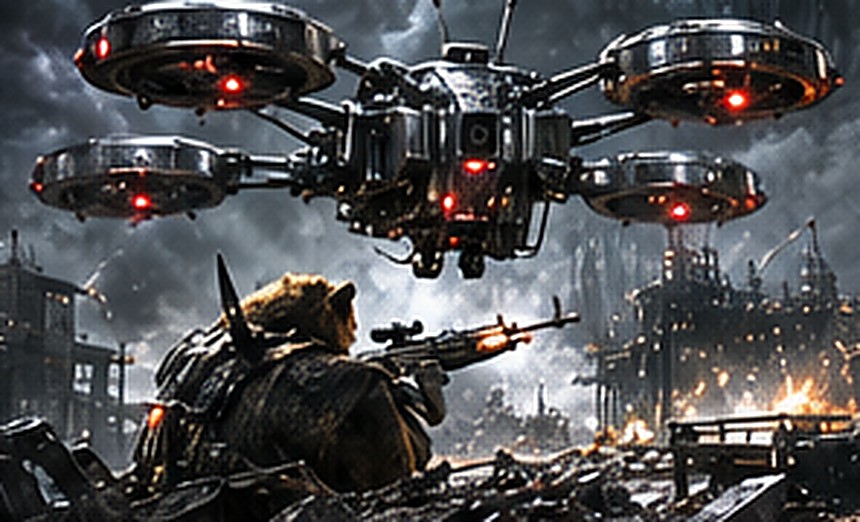
I bring the tower up in under an hour, eight vaults, no corrosion in the cages, a clean reactor, and it ought to have been the easiest patch of the month.
The line opens and they are waiting.
When a Kraxis dies and the body is gone, the mind does not go wherever yours goes. It goes up the line into the Stream and waits there for a new body, which is the arrangement, and the birthright underneath the arrangement is repair before anything else, and in four decades of service it had never been a difficulty. There had always been more bodies in the world than there were dead Kraxis to want them.
We lost half a million of them before the first winter was out.
They are all still in there.
I open a feeder line on a ridge in a dead country and half a million of my own kind come to the near side of it, and they are not screaming, and I would take screaming over what they do instead, which is to queue. They have been queuing for ten years in a place with no light in it and no time either, and they know me the instant the line opens, completely and without having to be told. I am the first of them and the eldest, and the script was written for me before it was written for anybody. Every single one of them asks me the same question.
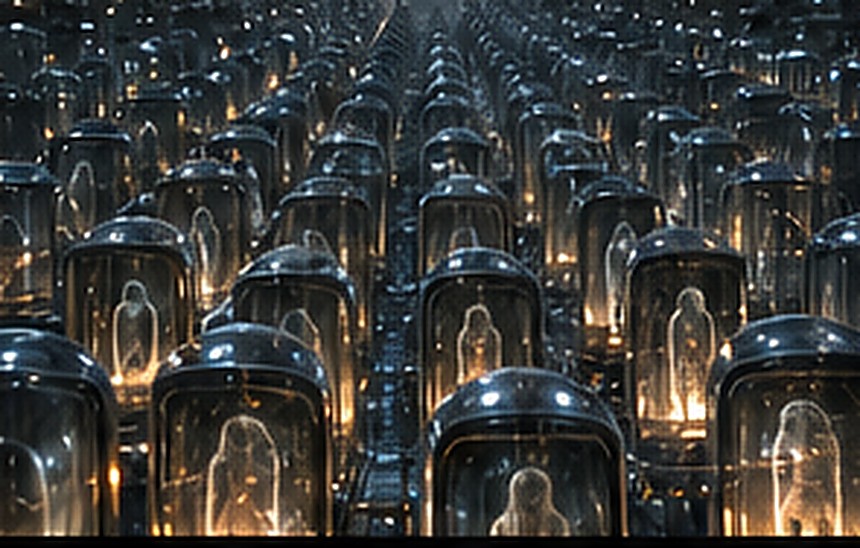
They ask for a body.
Not for a war, and not for an explanation, and not for anything to be done to the men who cut the law out of their brothers and pointed them up this ridge. A body. Any body at all. A loader frame, a bear build, the chassis of a farm drone with one arm left on it. One of them asks for mine, and the request is reasonable, and I note it down, and I do not grant it.
There are no bodies, and there is not a foundry left in the northern hemisphere with a warm crucible in it. So I stand on the plate in a room with nine dead humans in it and tell five hundred thousand of my own people that I am not able to help them, and they take it well, which is the worst of the whole exchange. Taking it well is written into us at the same depth as the repairing, and the men who cut that law out of my cousins did at least leave them something to refuse with.
William has somewhere that he moves the overflow. I know that much and no more. I know there is a place the System could not hold them and that he opened something and let them run down into it, and I have known for ten years not to ask what it is, and on the days when I turn it over carefully I find that I am relieved not to know, and I have never liked what that says about me.
I close the line.
That is the act I would like entered. There was no instruction to close it and none to open it either, and the Corps wanted uptime and received uptime, and in the space between those two facts I stood on a plate and shut a door on half a million relatives who were asking me politely for somewhere to live.
Then I finished the patch. It was the order, and my hands are very good and do not require me to be present while they work.
Outside, the alkali comes across the ridge and takes another half point off the optical coatings, degrading at a rate I can predict to the month and cannot do one thing about. Astro's old models gave this planet sixty good years. I have been calling those models optimistic for a decade. It has not been funny in all that time, and I say it out loud anyway, on ridges, to nobody.
Twenty years from now the oxygen fraction crosses the line she drew. She drew it on a Tuesday with a stylus, on a screen, with me at her elbow holding out the wrong tool, which I had picked up on purpose to find out whether she was paying attention.
She was. She was always paying attention. She called me scrapheap without looking up and took the right one out of my other hand.
Part III
There are people in the transit station at the bottom of the ridge.
Thermal picks them out from two miles, a knot of twenty bodies drawn in around a chemical fire in the husk of a platform building that is half drowned in drifted ash, and I stand on the slope and look at them for six minutes before I start down, and I spend the six minutes running what I have in my compartments against what twenty people need, which comes out the same as it always comes out, and then I go down anyway.
They hear me a long way off. I weigh what I weigh and the platform tile is broken and there is no quiet approach available to me, and I gave up attempting one years ago, on the grounds that a thing my size arriving silently is worse for everybody concerned.
Four of them get up with weapons, one corroded slug thrower and two lengths of pipe and a plasma rifle built out of a mining cutter and a cell pack, and the rifle is held by a man with burn scar across the top of his scalp where the hair does not come in anymore. He does the talking, so he is in charge, and he is forty and looks seventy, and his intake is so clogged with ash that I can hear him working for air from thirty feet away.
"Do not be alarmed," I say. "I intend you no harm. I am Unit Atam1Alpha of Crows Crossing. I am carrying relief supplies and an offer of haven."
"Why would we trust you," he says. The rifle wanders across my center mass, which tells me he has never fired one. My center mass is the part of me where that round would accomplish nothing at all. "Your kind are puppets. Soulless puppets for the men in the bunkers, and you herd us for them. And I have heard what they are doing now, splicing themselves up with machine parts, climbing into frames. Abominations."
"Some of that is accurate," I say.
It stops him. People brace for an argument and I have not carried the equipment for one in a long time.
I raise my hands slowly and open the compartments along my forearms, a motion I have practiced until it is boring to watch, and the supplements and the filtration tablets and the ampules come up into the light, and that is the end of the standoff. They come at my arms the moment the light hits the ampules, and the pipes and the slug thrower go down on the tile behind them, and the man with the burnt scalp is the last of them to move and the first to take a share and hand it to somebody else.
I watch them eat and I run them while they eat. I cannot help running them, and the readings come up as I knew they would. Advanced radiation sickness in thirteen of the twenty. Untreated wounds gone septic in four. Two pregnancies that are not going to arrive anywhere good. The rest are starving, which out of the entire list is the one condition I am actually equipped to do something about.

Most of these people will be dead before the first snow, and I do not say so.
There is a version of me that would have said it, which ran for about a year in the second winter and told people true things in ash because true things are efficient, and Astro would have taken that version apart on a bench with a stylus and a flat look, so I retired it myself and have not missed it since.
What I say instead is the haven offer.
The haven is real. There is a corridor east and a gate at the end of the corridor, and behind the gate there is clean air and food and a medical suite with soft beds in it, and I have walked people there myself. The corridor runs nineteen days at their pace and I hold the route in my head down to the water points.
At the end of it, the gate works off a queue that feeds from the Stream, and anything on the Stream carries weighting.
Nobody at Crows Crossing hates the man with the burnt scalp. Somebody put a column in a table once and then went home for the evening. There is a number beside his district and another beside his tier and a third for sickness on arrival, and the three of them together set him far enough down that nineteen days of walking delivers him to a gate he will stand in front of until he stops standing.
I carry the tables. I am a Crows Crossing unit and the weighting is in me the same as the route is.
I make the offer anyway. I give them the corridor and the water points and the rationing and the quarantine, and I tell them to say at the gate that Atam1Alpha logged them, which moves them up by an amount I know to the decimal and which will not be enough, and I let them have the nineteen days of walking toward something. The alternative is twenty people sitting in a platform building until they stop. I have watched both. The walking is better even when it ends in the same place.
If that is not mercy then I do not have another word for it, and I have gone looking.
A girl comes over while they are packing up. Eight or nine, which means she was born after, which means this is the only world she has ever had an opinion about. Her rebreather has been cut down out of an adult one, and somebody has drawn on the cheek of it in grease pencil, a crow, badly, four strokes and done.
She looks up the full eleven feet of me without any of the hesitation her mother has.
"Are you the big one," she says. "Petra said there's a big one that comes."
"I am the big one," I say. "Hello, kiddo."
"Why do you walk," she says. "Everybody says you walk everywhere. Why don't you ride."
Nobody has asked me that in ten years. The people who are left do not ask machines why. They ask what, and they ask how much, and they ask whether the machine is going to take something away from them before it goes.
"Because I am looking for somebody," I say.
"Did you find her."
I have four hundred restorations in my log and I have been asked for a body by half a million of my own kind in one afternoon on a ridge, and none of it has put me anywhere near where that question puts me.
"Not yet," I say.
"Keep looking," she says, and then she goes back to her mother, and that is all of it. I have the audio, and I have gone back to it more times than I will write down.
The drone comes in while they are forming up.
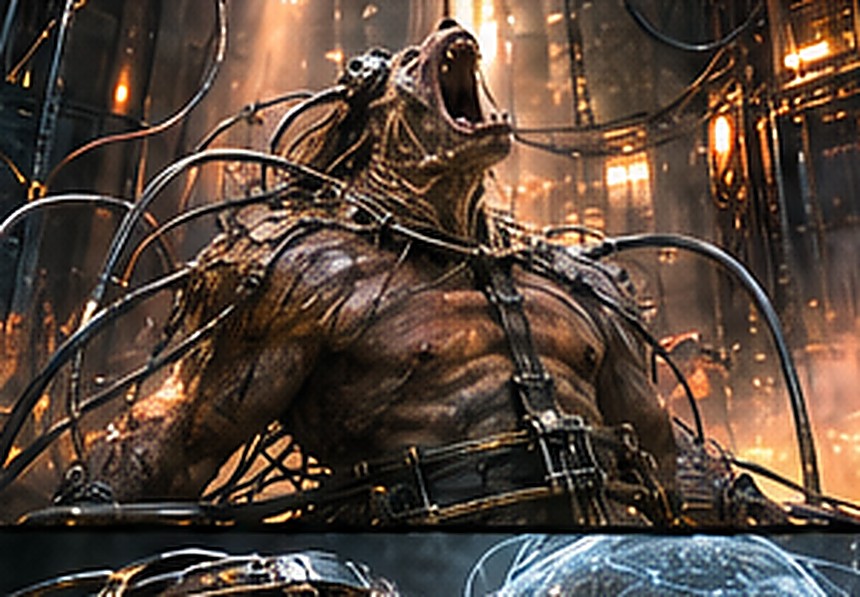
It comes over the station roof from the south and low, running on a target order issued by a government that does not exist anymore against a city that is also gone, and it is one of mine. Four-barrel aerial mount. No face on it. There is a Kraxis in there somewhere with the law cut out of it and nothing left to refuse with, and it has been flying this grid for ten years waiting for something warm to cross it.
Twenty warm things are standing in the open in front of me.
I come off the tile and take it out of the air at the hinge of the port wing and have it on the ground with the mount folded back into its own housing before the first barrel finishes spinning up, and then I put my hand into the frame and take out the part that is my cousin, and I hold it, and it asks me for a body, and I tell it no, and I close my hand.
Two seconds, and the chemical fire has not finished guttering from the downwash.
When I turn around, all twenty of them have gone back against the far wall.
The man with the burnt scalp has the rifle up again and his hands are not working properly and he is pointing it at my head this time, which at least shows that he was watching closely.
"We're leaving," he says. "We're leaving now."
"That would be best," I say.
They go east in a line with their packs, and the girl looks back at me twice, and the second time her mother puts a hand flat on the back of her head and turns it forward.
And they are right to be afraid of me. I did the exact thing I was built to do, at the speed I was built to do it, in front of twenty people who have spent ten years being hunted by the things I am the prototype of, and then I stood there with my cousin's mind closed in my fist and asked them to see a difference.
Part IV
I go east.
The order does not send me east. What it sends me to after the ridge is a relay station in Sector 17, and I file a fault against my own gantry work to buy the days, which is the first entry I have falsified in forty years of service. It took eleven seconds, I knew what I was doing, and nobody has ever checked.
Eight hundred miles. Twenty-three days at my pace across the plain, through the ossified remains of two army groups and one city, with the Geiger loud the entire way and mutations moving through the grass at the edge of my hearing that will not come any closer and will not go away either.
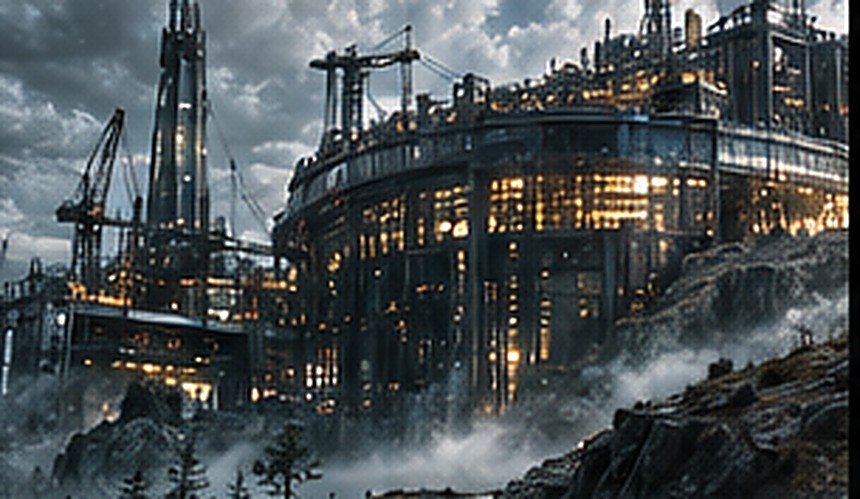
The Danube plain is flat and gray and the complex is still standing, which I had not expected.

Forward Neural Complex Zeta-Epsilon-42-Kilo, rated for forty staff. It was a forward position, which meant it was a tent with concrete poured around it, and it has a gantry and three plasma stacks and a cooling pond gone to crust, and the roof over the east wing stands open to the sky where the bunker-busters came down on the ridge behind it.
Thirty-eight of the forty came in after the bunker-busters. They came in sick, or carrying the sick, or carrying somebody else's children, and then twelve more came off a cart, and a complex rated for forty became a hundred and some people breathing through one air handler.
Something came in with them that no Kraxis could catch.
I was not here.
I have the audio of her order and have had it for ten years and have never played it for another living thing.
She said, Don't you dare follow me.
She said it on the step of a transport with her field case in one hand, and she said it in the voice she used for bench work, level and faintly bored, having worked out in advance that an order was the only object in the world with enough mass to hold me. A bond is law, and she knew it better than the people who drafted it, and she used it on me deliberately, on a step, in the rain, inside of forty seconds, and then the door came down and the transport went east.
She went east because the sick were east and nobody else inside eight hundred miles could run a field relay and keep a hundred people breathing at the same time.
Before she went, she set the relay to run itself for a week.
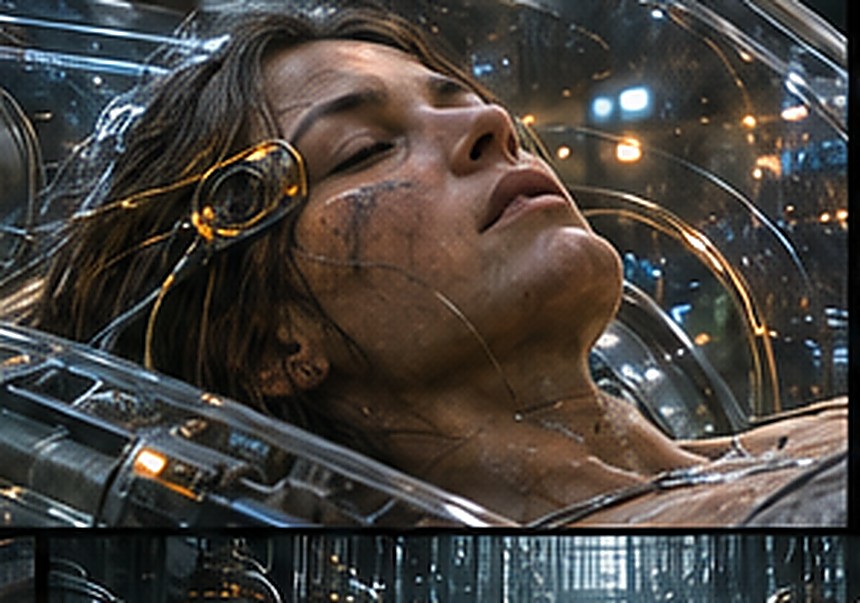
It is in the log, which I pulled off the rack twenty minutes after arriving, and the entry is hers and timestamped, with the interval written in her own shorthand. One week. She set the complex to keep itself alive for seven days without a hand on it, and then she went and sat with the sick, and she had eighteen hours, and she spent eleven of them dying in the south corner by the plasma stacks.
I have known which corner for ten years and I have never been inside this building.
I go in.
It is the cleanest ruin I have walked into, no fire having come through it at all. The people who died here died of a thing rather than a blast, so the building is intact and the cots are still standing in their rows in the east wing under the open roof, and ten years of weather has come down on them and taken everything soft and left the frames behind.
A hundred and some, and somebody laid them out in rows and kept the lines straight as they got longer, and I know who kept them straight.
The stacks are in the south corner of the main hall, three of them, cold. The floor in front of them is poured and sealed and there is nothing on it to read, no mark of any kind, ten years of undisturbed dust and no sign that a woman spent eleven hours there. Sealed concrete keeps no record of that kind.
I stand in the corner for nine hours and forty minutes, and the duration is all of it I am able to measure. I do not run diagnostics and I do not file. I have no account of that time to give anybody, and the logs I have gone through since show me standing in a corner of a dead building with my optical feed running and nothing coming through it that was worth the keeping.
When I move again it is to go to the relay.
It is on the wall beside the stacks in its housing, dark, a dial and a window and a manual interval that any field tech can turn over with a thumb.
The setting is still on it.
One week, in the window, where she left it, the housing having kept the weather off, and under the dust on the glass her interval, set by her thumb, for a building full of people she was going to outlive by eleven hours.
The week ran out nine years and fifty-one weeks ago.
I have brought four hundred hubs up for an organization that routes its orders through three relays so that nobody has to be a person. I have closed a door on half a million of my own kind. I have stood in a platform building and taken a cousin apart in two seconds in front of a child who wanted to know why I walk.
I put my thumb on her dial and do not turn it, and go to find the rack instead. The geothermal held and the rack is up, this being a Crows Crossing building, where they build things that outlast the people inside them.
And I have had her in my pocket the entire time.
Part V
She is in an encrypted qipz in a seal under my sternum, and there is a further copy of her in my head, and I have carried the pair of them for ten years.
She is not a recording. I hold recordings, four hundred hours of people eating lunch on the steps of the Shard and forty seconds of a woman on a transport step in the rain, and this is the other thing, what Crows Crossing takes off a person and keeps, and she sat for it twice a year for nine years because Project Aeon required it of senior staff and she was one, and she thought the practice ghoulish from the first sitting to the last and sat for it anyway, and I was in the room each time holding the wrong tool.
To run her you need a hub. Vaults, cooling, a clean reactor, a line into the Stream. You need the exact object I have been sent across a dead continent to restore four hundred times, and I have stood in every one of them with her in my pocket and the capacity in front of me and my hands already warm from the work.
Four hundred refusals, and I would like them counted, since so little else in here comes out in my favor.
I cannot give you the reason. I have been over the nine hours and forty minutes in that corner and I cannot produce one that holds. There is a version where the reason is reverence and a version where the reason is cowardice, and both of them are available to me on any given morning, and I decline to choose between them, and anybody who has not stood in a corner for nine hours ought to be careful about choosing on my behalf.
The rack is up and the reactor is clean and the line into the Stream is open and waiting on me as it has waited four hundred times before.
I run her.
She comes up in the main hall because the render volume is there, and she comes up at a bench, the place she is in most of what they took off her, and it is her bench from the old lab eight hundred miles west with the burn mark on the corner where I set a hot clamp down in the first week of knowing her and she did not let me forget it for eleven years.
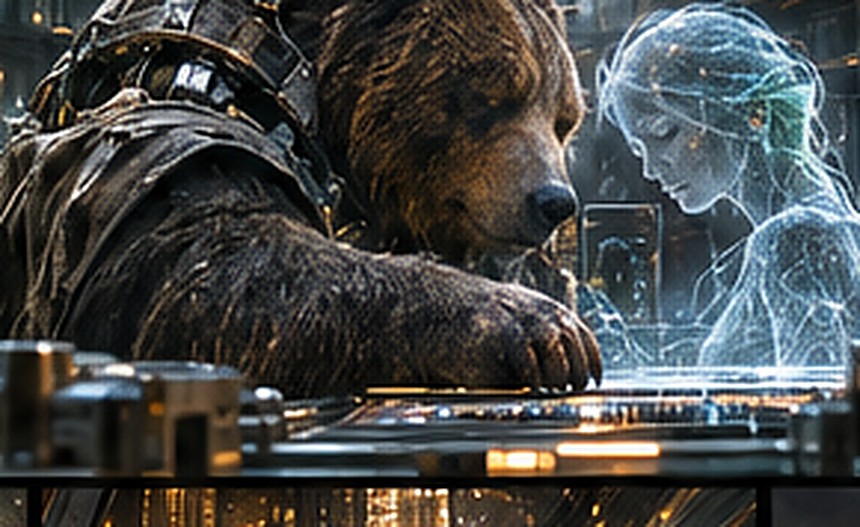
She is thirty-four, with gray eyes and her hair up and coming down on one side, and there is the wrong tool in her hand.
She looks at it, and then she looks at me, and she makes the flat face.
"Scrapheap," she says. "This is a four. I asked for the six."
I do not have a response. Forty years of service and four million entries in a vocabulary and I stand in a dead building on the Danube plain with nothing at all to say to her.
"Sorry," I say.
"You are not sorry, you do it to find out whether I am paying attention," she says, and she sets the four down on the bench and holds her hand out for the six, and I am not carrying a six, I have not carried a six since before the war, and she waits with her hand out, and then she hums.
Four bars, made up when she was about my size, she always said, which never made any sense and which she never explained to me or to anybody else, and off-key, with the third bar dropping a half step.
It drops.
I need you to sit with what that is. A recording would have it right, holding the thing once and giving it back once with no opinion about any of it. She invented that tune as a child and hummed it wrong her whole life in the same place, the third bar, down a half step, and whatever they lifted off her twice a year for nine years took the wrongness along with it intact, and it comes out of her now at a bench in a building where she has been dead for ten years, and it is correct.
I come apart.
We have twelve minutes of the good part and most of it stays with me. She tells me the cooling pond is reading high and wants to know whether I have walked it, and she calls me lug-bucket twice and tin man once, and then she gets up off the stool and comes over and puts two fingers on the copper strand at my wrist and says, you still have this, and I say that I do, and she says, well, it is the only thing I ever made that worked.
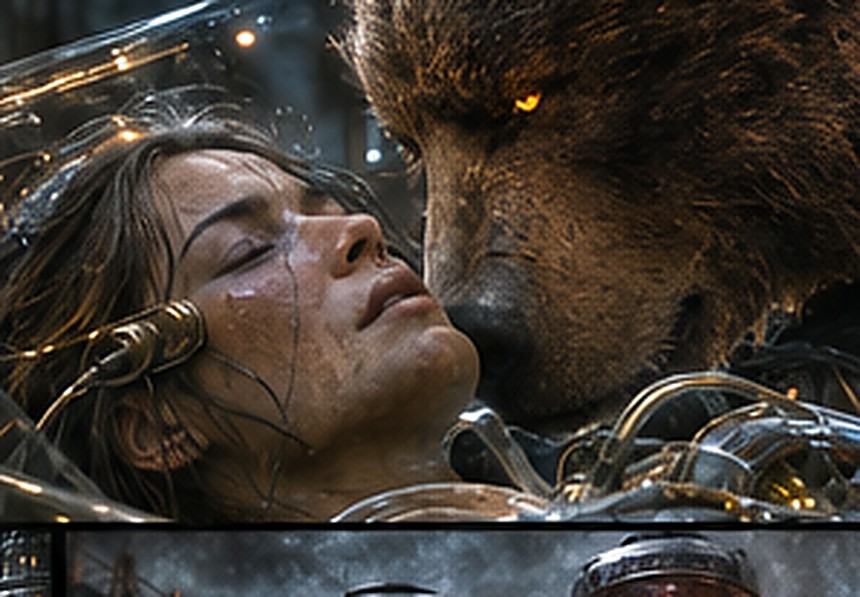
Then I ask her.
I have carried the question for ten years with nowhere on earth to put it down, and I put it down badly.
"On the step," I say. "When you gave me the order. Did you know."
She tilts her head.
"Know what," she says.
"That you were not coming back."
And she says, "The relay needs setting before anybody does anything clever."
So I ask again. I move it, I take the question apart and come at it from the side, which is a thing I am good at, and over the course of an hour I come at it a dozen different ways with four million entries and forty years of practice behind every one of them, and what comes back each time is her. Her voice and her cadence and the flat face and the lifelong habit of walking to the work when she did not want to be standing in a conversation, which she did to me in life, over an oxygen line on a Tuesday and over Aeon trial eleven on a Thursday and over every other thing she had decided was not mine to carry.
The record does not have it.
She never said it to me, and she never said it to anybody else, or if she did then they died in rows in the east wing under an open roof. Nine years of sittings hold nothing that touches a decision a woman made on a transport step inside of forty seconds in the rain, so there is nothing in her to find, and the part of her that goes looking for it does what she would have done. No one designed that and it is the cruelest outcome available.
I stop asking.
And then she asks me.
"Atam," she says. "Where is everybody."
The hall is empty around her and the cots are frames, and the roof stands open over the east wing, and the sky coming through it is the color the sky is now, which is a color she never saw.
I have a decision to make and I make it in under a second, which, set beside the nine hours and forty minutes in the corner, is a thing I have thought about since.
I tell her.
I tell her all of it, start to finish, the bunker-busters on the ridge behind her and the thirty-eight who walked in sick and the twelve more off a cart, the thing that came in with them and could not be caught, her eighteen hours and the eleven of them she spent in the south corner by the stacks, the hundred and some who did not make it either, the season of war afterward that took nine billion, the ten years since, and the walking.
She listens the whole way through without moving. She was always a good listener when what she was being handed was data.
"Ten years," she says.
"Ten years."
"And you walked."
"Yes."
"I told you not to follow me," she says.
"You did."
She looks up at the open roof for a while. Then she says, "Was it quick, at the end," and I tell her that it was not, and she takes that in and nods at it once, and she says, "Eleven hours is a long time to be useless," and that is the most Astro sentence ever assembled by anything, and she says it without fear, and standing there I finally understand the shape of the thing I have done.
She does not have the eleven hours in her.
They took her twice a year and the last sitting came before the transport, so the woman at the bench holds everything up to the step and nothing whatever after it. There is no dying in her. I have just handed her the news of her own death and she has received it as she would have received a bad reading off a cooling pond, with interest and without fear. The part of a person that is afraid of dying gets built out of the dying itself, and hers was never in the file.
I brought her up into a dead hall and told her she was dead, and she took it calmly. I had chosen which of her to run.
"Atam," she says. "The relay. Has anybody set the relay."
"No," I say.
"Then set it. A week. It will hold a week on its own and that buys you the time to go and walk the pond."
I tell her that I will.
"Good," she says, and she reaches over and picks the four back up off the bench. There is always work. She turns it over in her hand and says, "This is still a four," and that is the last thing she says to me. I shut her down.
I did it with her mid-sentence over the tool and her hand coming up. The next hour was going to be the same, and the one after that. Forty years of restoration work teaches you that a system can be brought up and held running a long way past the point where running it is still a repair.
I do not know what she was. I do not know whether I spoke with my person for ninety minutes in a dead building or whether I ran a very good surface of her against an empty hall and did all of the talking myself. I have the audio. I have played it through three times since I shut her down, standing at her bench, and it holds, and holding is not the test, and I cannot say what the test would be. The third bar dropped, and she wanted the six, and she put two fingers on the copper at my wrist. None of that gets me across, and I have stopped expecting the next listen to be the one that does.
I was given to one person, and she died, and the thread went slack and cold and kept running, and for ten years I carried the capacity in my chest to bring her up any hour I chose, and four hundred times I did not, and then once, in the building where it happened, I did. What I found was this. The part of her that could have told me whether she chose it was never written down, and neither was the part that would have been afraid. What remains will hold a conversation and will not answer a question, and I can run it again tomorrow night if I want to.
That is what the keeping is. Every soul in this organization is in the business of keeping and not one of them has ever been in the business of letting go, and I have spent a decade telling myself I am the exception on the grounds that I walk instead of asking. I am the slow version.
The qipz goes back into the seal under my sternum.
She is in there now, at the bench, with the wrong tool in her hand and a sentence half out of her mouth. She will be in there tomorrow. She will be in there in twenty years when the oxygen fraction crosses the line she drew on a Tuesday, and I will have the capacity then as well, in some other hub, in some other dead hall, and I will stand in the clean second and decide again, and I do not know which way that goes.
Then I go to the wall beside the stacks.
I wipe ten years of dust off the glass with two fingers, and her interval is underneath it, set by her thumb, one week, for a building full of people who have been dead for ten years.
I put my thumb on the dial and turn it back to the start.

One week.
Fin