File No. 013 Classification — Dark Erotic Fantasy The Drowned City
Short Fiction
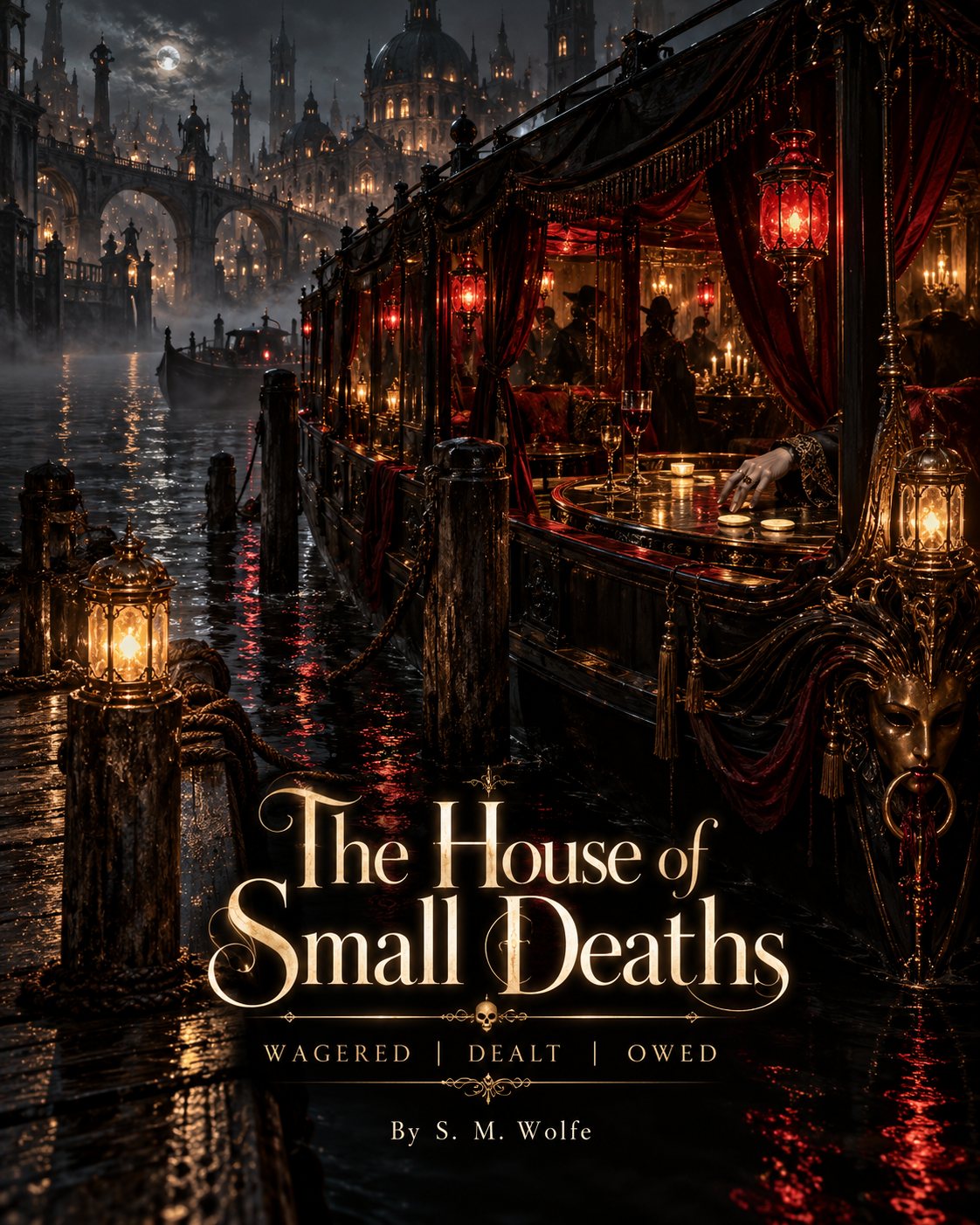
The House of
Small Deaths
WAGERED | DEALT | OWED
“The danger was never that you might lose. It is how sweetly you will beg to, once the glove is off and the bare hand is on you and you have felt, for the first time in your safe and careful life, the whole difference between being wanted and being taken.”— The Dealer
“Leave your name at the plank. You will not miss it, and the House will put it to better use than you ever did. What you carry aboard you do not carry off, and there is no off.”— cut into the beam above the gangway of the House of Small Deaths

There is a sound a self makes when it comes loose. Wet, and small, and almost grateful.
The dealer had drawn that sound out of a drowned city of strangers across the black glass of her table, and she had never once heard it break from her own chest. She had made her peace with that a long time ago. It was the flat worn peace of a hull moored between two shores and bound to touch neither. Then a stranger sat down at her table and slid a chip across the felt that she could not name until her fingers had closed on it, and it was her own laugh, bright and unguarded, a sound she had not made in twenty years. The cold quiet she had carried for all of them went out of her between one breath and the next. It was air she had held so long she had taken it for the shape of her own chest.
They called the place the House of Small Deaths. No one who worked the water called it anything but the House. No one who had truly lost there called it anything at all. When this water took the rest of a person it took the words for it too.
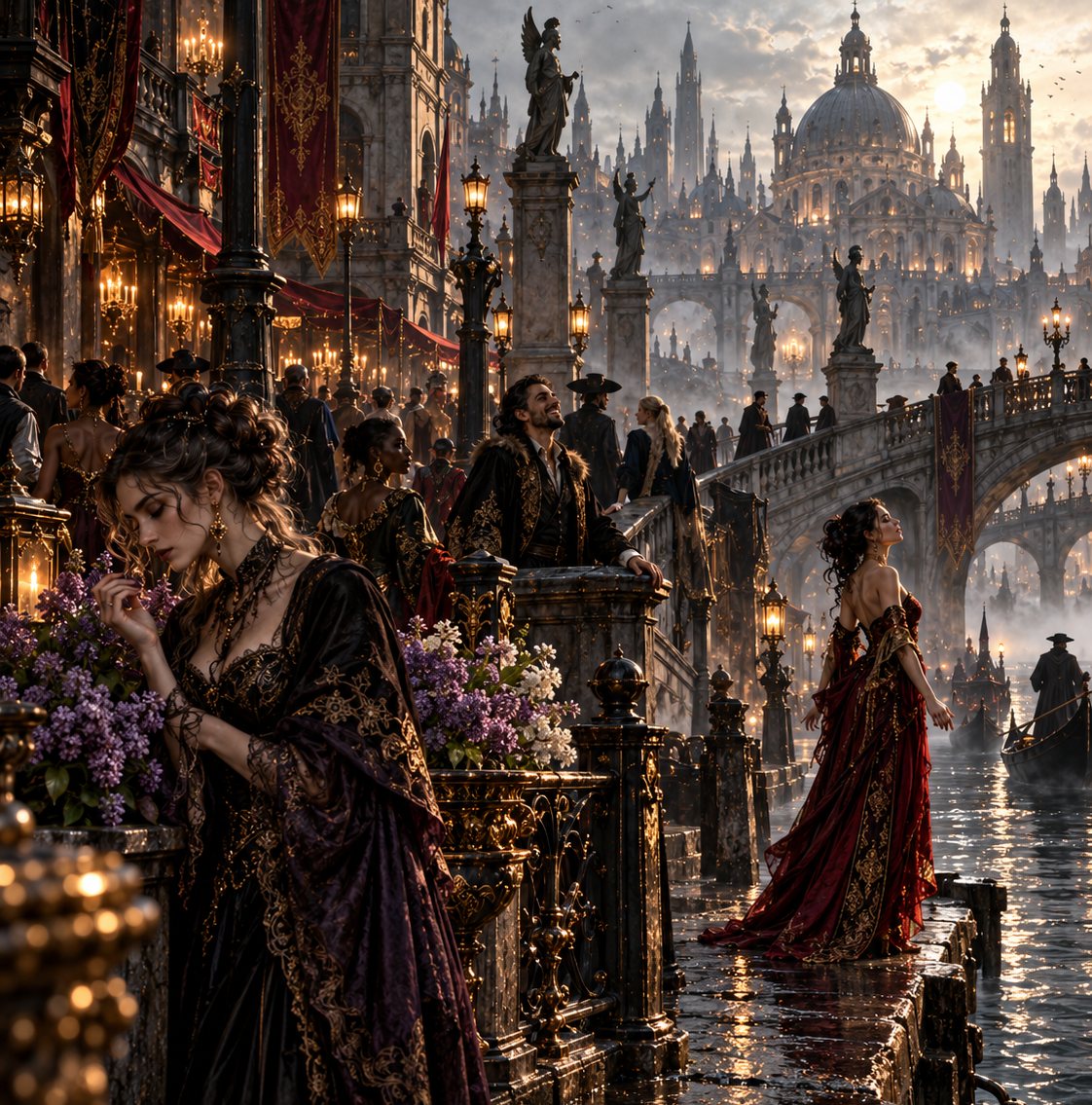
The House was moored where the canals gave up their names. Past the lantern quarter, past the last bridge anyone still troubled to light, where the water went flat and black and quit pretending to hold the sky. The pleasure-city ended at her gangway. Two lamps burned on the mooring posts, the last two lit this far out, and past them the water opened into a black field with no far edge. Everything on this side of that edge was hers. All of it had belonged to someone else first. She had given up minding that a long time back.
The water under the barge was older than the city that dressed it in lanterns. It had come up from wherever the maps ran out and taken the canals for its own road inland, and the men who drained the marsh and raised the bright quarter over it had never gotten the one thing from it that mattered. It measured no hour the same twice. A night aboard could be a night, or half a life, and no two clocks carried down her gangway had ever agreed. The House lived in the gap between them, in the dark reach between what the water took out of a person and what they were left remembering it took. People felt the water before they ever saw it. It was the old tug behind the knees on a high bridge, the small cold voice under every railing that said step off, you were always going to. Most turned from that voice all their lives. Hers came down the plank to answer it.

The game was simple, and everyone mistook it, and the mistake was the first thing the House lifted off them.
No one staked coin at her table. Coin was what the fools in the bright rooms overhead lost, and coin came home again. Here a player staked the self, piece by piece, the one currency that did not. A summer. A face once loved. The sound of your own name in the one mouth that ever said it like a blessing. The nerve to fall, one more time and all the way, in love. Each was a piece a person carried and swore they could never be parted from, and each came free with a clean and terrible ease, once the dealer had learned the trick of lifting a soul off what it believed itself to be.
She was the one who lifted it.
When a player won, the House paid out of its own body. It paid out of everyone who had sat there before. Take a hand off her and you might reach into the bank and draw back the very piece you staked, made new, or draw a stranger's instead. There were men in the bright quarter wearing summers that were never theirs, women who had come down to be rid of a love gone to vinegar and had risen wearing a sweeter one, lifted off some soul who could not hold his cards. A player could walk off her table carrying more of a self than he brought onto it. That was the lure, and no part of it was a lie. It was only that a hand was a hand, and the bank was a sunken city deep and never ran short, so across a long enough night no one took the bank. They took each other. They lost themselves. And they came back down the plank to try again.
Where a thing was kept decided how it had to be taken. A stolen afternoon rode shallow, high under the jaw, and came away on a fingertip. A first love kept to the lips. Grief banked under the sternum, hard against the bone, and for that she had to press, lean her weight on a man until it gave. But the stakes that built a person, the ones they would swear their life on and were the reason they had come down to be rid of, those lay low, in the deep hold where the body keeps its wanting, and there was one road in and it was the long road. The House had never pretended otherwise. No one walked out of a true loss. You were taken down through it.
She dealt gloved. Always. Black silk to the elbow. The bare hand was the instrument, and an instrument left out on the table got dull, or stolen, or used. When a stake was laid she peeled one glove down, slow, finger by finger, and the table leaned toward the peeling, every face at it knowing somewhere under the wanting what the bare hand was for.
A woman came to her that night ahead of him, sure she had enough of herself to spare. She staked a summer. The dealer did not ask which. She laid her bared palm flat to the pulse under the woman's jaw, where a season is kept, and she took it.
It came as everything came, a rush and then a slow spilling. The woman's spine drew up off the chair. The small wet grateful sound broke out of her, and a full July poured out under the dealer's hand, cut grass and a boy's unschooled fingers at the top button of a dress and a lake the woman would fail to find again for the rest of her life. It beaded warm on the dealer's fingertips and cooled in a breath to a pale disk the size of a coin, the summer sealed in it like a fly in amber, a small light already going out. The woman slumped, loose and stunned and lighter by a season. She touched the hollow below her ear to find the place it had left from, and found smooth skin, and smiled, and thanked her. They thanked her. This one would climb the plank lighter than she came down it and sleep that night without a dream, and some evening years on a stranger would say the word July in a warm room and she would have to get up and go stand in the cold and weep and never once know the name of what she was weeping for. The dealer had taken that too, the knowing, and set it on the bank beside the cooling July.

She felt nothing. That was the work. The nothing was the whole of the work.
The game reached every hand at the table but hers. She was rich past any counting in other people's lives and could not have told you the first true thing about her own.
You could pick her old clients off the bridges by daylight if you had the eye. A man who went white at the smell of lilac and could not say why. A woman lovely and untroubled and short one whole year, the one that used to teach her fear, who stepped off the same quay twice a month, light, smiling, with no one left inside her to finish the thought about how far down the water went. The city called them the light-footed and envied them their ease and did not walk them home. They were the lucky ones, her small bettors, the ones who gave up the single piece that hurt and rose from the chair with enough of themselves left to rise. She did not trade in luck. Luck was for the bright rooms. Down at the black end they dealt in the going all the way, and the ones who sat for that rose from no chair and crossed no bridge again.
By the turn of the tide the House had near emptied. Six lamps in red glass burned low, their light the color of old brass, the smoke off them pooling flat under the ceiling, too heavy to rise. The table was one slab of black glass the length of a coffin lid, and it held the lamps in it as small drowned suns. Down its spine lay the bank. Her winnings, everyone's losings, stacked in leaning columns of pale disks, each lit faint from the inside by the life sealed in it, so the table glowed the used white of old pearls. They were not dead, the disks. Dead would be a mercy, and the House did not deal in mercy. They were kept. A multitude of selves cooling in the dark and awake in it, each still sure it was the person it had been lifted from, and when the barge had gone quiet and the last player had climbed the plank you could set your ear to the black glass and hear them, a low massed murmur under the timber, every stolen summer and name and love still going faintly on in the dark, with nowhere to go and no one left to carry it out.

The barge rocked on the water. Timber ticked and settled. Under the boards the canal worked at the hull with a slow wet patience, and the room smelled of tallow and cold water and, under both, of the sweetness a body leaves off when it has just been eased of what it loved.
He came in on the last of that tide.

She did not see him arrive so much as feel the room take a new weight, the hush that spreads on flat water when a stone has gone in somewhere out past the light. He was neither young nor old. He had the face of a man who was handsome once and gambled it and won a quiet in its place, a stillness, a terrible ease, and a thin white scar through one eyebrow that someone who loved him once must have learned by heart under a thumb. He did not look at her hands, which is what a man looks at. He looked at her mouth, then at her eyes, as if he had come a long road to see whether they were still empty, and found that they were, and was not surprised, and was not, under the not-surprise, unmoved.
"Deal me in," he said.
"You stake to sit."
"I know the House rules." The corner of one eye creased, short of a smile. "I helped write a few of them."
He laid down a memory first, a careful man opening small to feel the table. She took it from the inside of his wrist, glove peeled to the knuckle, and it was a little thing, a rain, a doorway, a coat that smelled of wet wool and tobacco. He shivered under the bare touch and let a breath go, and she felt the loss leave him, and she felt, as she always felt, nothing coming back the other way, and he watched her face while she took it as if her nothing were the loveliest sight he had met in years.
They played the hand. Her cards were thin squares of the same pale stuff as the disks, blank as blind eyes until they turned. A turned card clouded, cleared, and a scene stood up in it no bigger than a thumbnail, moving, lit from within. His rain came up in the glass. A gray doorway. A hand pushing wet hair off a face she would not see whole. Then the card went blank and the rain was hers, and his life had a doorway gone out of it he would never find the frame of again.
He lost the hand and minded so little that she looked at him twice. The ones who did not mind losing were the only players she had ever learned to fear, and there had been few, and none in a long time.
"Again," he said.
He staked deeper the second hand, and deeper the third. A stolen afternoon she lifted from the soft notch of his collarbone with two bare fingers, and he tipped his head back to give it to her. A first love she took from between his lips, her thumb drawing the lower one down, the memory rising on his breath and crossing into her warm and green and another woman's. Each stake sat lower in him than the last, and to reach each one she unpeeled another length of black silk, and the table that used to lean in had thinned to smoke and the two of them, these not being stakes a man lays down in company.
He staked a name a woman once sobbed into the side of his neck, and a stake kept that deep would not rise to a wrist. She opened his shirt to the waist and set her bare mouth over his heart and drew the name up through the skin, slow, with tongue and teeth, and he arched off the chair and the sound he let go traveled down through the timber into the black water and came back lower, and older, and not all his. She straightened with a stranger's name cooling on her tongue like a coin she had no mind to spend, and she wanted. For the first time in twenty years she wanted, one hot thread of it standing up in a place banked cold so long she had forgotten it could carry a current, and she gloved the hand fast, before he could see the wanting lying face up on the felt between them.
He would not let her cover it. He staked the first night he was ever wanted for his own sake and not for what he might be won off someone else, and what built a man banks lowest of all, down in the deep hold, and there was only the long way down to it. They both knew this. Neither pretended not to. She came around the felt and gathered her skirts to her hips and took him into the dealer's own chair, and she took the stake the single way a stake cut that deep can be taken, settling onto him slow, taking him in to the root while the memory worked up out of the dark of him and into the dark of her. His hands found the laces down her spine and drew them loose without asking. Asking was a shore they had left an hour back. His hands closed hard on her hips and set the pace the deep stake needed, slow and then not slow, and they worked it up out of him inch by inch, and when it tore loose at last he spent the memory into her on the same breath his body spent, both at once, both hers now, and the stolen night went off inside her like a swallowed coal. The cold banked country of her broke its long drought and flooded bank to bank. She was shaking, open, astride a stranger in her own chair, taking the long deep road down for a stake she could have lifted off a fingertip, an act this body had forgotten it was built for.

He held her hips through the shaking and watched her feel it, and the tenderness in his face frightened her worse than any ruin she had drawn off anyone in all her years at this table.
"There it is," he said, low, watching her come back down, a man watching a long shot run home. "I wondered if there was a live nerve left in you anywhere."
She lifted off him and laced what she could reach and climbed for the cold. Her heart, which she had not consulted on any matter in two decades, was beating in a manner she would have named, in a stranger across the felt, a tell.
"You are down to nothing," she told him, and it was true. His side of the felt was bare. She had stacked his rain and his first love and every stake she drew up out of him that night into the bank with all the rest. "You cannot buy back in on an empty hand."
"I am not empty." He reached into his coat, or into the air, or into the black water under the hull, she could not afterward have sworn which, and laid a chip on the felt and slid it to her.
It was a small pale disk, cool, a chip like any other, and she reached to bank it, and her fingers closed, and she could not name what was in it. That had never happened. She could name any life at a touch. That was what she was. She turned it in the lamplight, and it played, unbidden, blooming up off the felt with no hand of cards to call it, and the scene was a woman young and unafraid throwing her head back in a doorway she had never stood in, and out of the woman came a sound, bright and unguarded and with no calculation anywhere in it, and it was a laugh, and it was hers, and she had not made it since before this water had her.

"Where did you get that." Something cracked in her that had not cracked at this table in longer than she could hold in her head.
"The usual road." He leaned back. "Someone lost it here. A long time ago. The House has sat on it ever since, as it sits on everything handed across this felt, and I have given up more than you would credit winning it back one small hand at a time, to carry it down here and set it in front of the one person alive who does not know the sound is hers."
The smoke had come lower. The other players were gone, or had never been there, or were the pale disks stacked at her elbow. She was no longer sure. The not being sure did not frighten her. It felt instead like a fog she had squinted through for more years than she would own to, thinning at last to let one clear shape stand.
"You want to play me for it," she said.
"I want you to play. Full stop." Gentleness on him was the most dangerous card in the deck. "You have dealt this game to all the drowning city and never once sat in the chair on my side of the glass. You take, and take, and feel nothing, and you have told yourself all these years that the nothing is strength. It is not strength. It is the safest and most thorough way there is to be dead and still draw breath. I have watched a great many people lose everything at this table. I have never watched one as far gone as the woman dealing."
"To play, I stake."
"Yes."
"Something of my own."
"Yes."
And there was the joke she had lost the ability to see. She reached into herself for a self to wager, a summer, a face, one small parting of her to lay down and buy her own laugh back, and she found nothing in there to lay a hand on. Not the nothing of an empty purse. The nothing at the dead axle of a wheel. She went down through herself, past the gloved cold dealer, past the banked years, and she kept going and there was no floor, there was only the bank, the pooled and shining pot of everyone who had ever sat and lost, a sunken city's worth of summers and names and unspoken loves stacked and cooling in the dark, and it was not that she owned them.
It was that she was them. There was no dealer under the dealer. There was only the debt.

"You worked it," he said, and there was a note in his voice now near to grief. "Most never do. The House cannot leave the table, love, the House not being a person who runs the game. The House is what is left when a person loses the last of themselves and has nothing to hand across the felt but the emptied hand. You sat where you are sitting once. Twenty years back, or last night, the water keeps no good clock. You staked and staked as I stake, for the ruin of it, one of the ones only awake at the lip of losing it all, and you went all in on the single bet the House cannot cover. You wagered whether you could lose completely and still be there to feel it. And you lost. And the losing made you the bank. You have paid yourself out to strangers a disk at a time ever since, and called it a profession, and felt nothing, there being no you left in you to feel."
The barge shifted on the black flat water. Above them the last bridge no one lights went on not being lit.
"Then I have nothing to stake," she said, and she heard the old cold dealer in her working to close the table, to glove the hand and go back to the cold. The cold was terrible and the cold was known, and the known is the last thing any of them hands across. "You have brought me my own laugh to look at and shown me I have no coin to win it with. That is a cruelty even for this water."
"You have one stake left." He did not touch her. He wanted her to reach for it on her own, and that he would ask it of her and not do it for her left her barer than any bare hand had in a long time. "You can wager the House."
And she understood him.
Not a piece of her. There were no pieces of her. She could lay the whole bank on the felt, every pooled and stolen life, the entire pot she had become, and go all in on the one bet she lost the first time, whether a self can lose all the way and still be there, at the bottom of the losing, to feel it happen. She could play the hand that made her, and play it to lose on purpose. She could cash out.
"If I lose," she said.
"You come apart. All of it goes back to the water. Every disk. No stranger gets anything back, there being nothing to give back, there never was, that was the first lie of the House. And you are gone. Which is the only door left out of the chair."
"And if I win."
He smiled then, all the way, and it was a beautiful ruined thing. "No one wins this hand. That is the one reason it is worth sitting down for."
For the first time all night the ease went out of him. "Someone sat where you sit once," he said, quiet now. "Back when I was the one who could not rise from the chair. She lost to me on purpose. She dealt me the whole road home, and it took the seat off her, and she paid without a word. I have told myself a hundred years that she did it out of love, and she did, and that was never the whole of why. She was tired. You get tired, in the chair, of feeling nothing with such skill at it. The freeing frees the freer too, into the one rest left to a thing like us, which is the cold and the long sitting still. I gave back everything I won since the night she let me go, every bright piece of it, learning your face across a felt, and I would like to tell you I came down here only to open a door for you. I came down to lay my own weight on the table at last. Do not love me for it. There is a barb in the kindness, and it is set in me."
She looked at him and understood all of what his coming had already cost him, and that he had come the road anyway.
He leaned in until she felt his breath at her ear. "L'appel du vide," he said, low, in a tongue the black water is old enough to remember, and he did not translate it, and she did not ask, having heard it rise off this felt night on night for years and called it her trade.
She peeled both gloves off. Finger by finger, slow, and there was no table left to lean in, only him, and the smoke, and her own bright unspent laugh turning on the felt between them, throwing back a light she did not remember owning.
She put her bare hands flat to the black glass, palms down, every life she had swallowed laid out under them, and she pushed all of it to the middle.

He came around the table, or the table went, and there was no felt between them, only the two of them on the shifting floor of the barge with the black water an inch of timber under her spine and the drowned city holding what breath it had left. In the chair she had taken him. Here she was the taken. He laid her back across the black glass among the cooling disks of everyone she had ever swallowed and he set his mouth to her low and took the long road, the deepest road, the one she had walked a thousand strangers down and been walked down by not one, and there was no silk left to peel and no distance left to deal from and no dealer at all, only a woman opened the full way down to the deep hold, past speech, past pride, her hips lifting to meet him of their own mind, begging aloud in a word she had taken off so many strangers and never once let out of herself. He took her there until the begging had gone shapeless. Then he came up the length of her and into her and she took him in, and there was no bottom to it, only the black water opening in her with no floor, and the two griefs of them, his road home and hers, ground together in the dark with the kept lives glowing and murmuring under her spine, and she made a sound.
It was the small one. The wet one. The grateful one. And for the first time on this water it was hers.
She went all in.

A loss, done all the way, is the one prayer the body still has by heart. Every disk she had ever stacked, every stranger's stolen summer and murmured name and unspent love, tore loose from the bank at the peak of her and poured out through the single act, each small death it ever took spending itself through one body in a single breaking. And every one of them woke as it went. The whole kept and murmuring city came up at once into the light of the one act and knew, each of them, for the one second it took to pass through her and out, exactly what it was and who it was that had emptied it. And then they forgave her. She had braced a lifetime for their rage and had no brace at all for this, a flood of pardons she did not earn and could not hand back and could not set down. But they were not going home. There was no home under this water. There was only the water, which keeps nothing and forgives nothing and had been hungry since before the city had a name, and it opened under all of them at once and took them back along with everything else it had ever had, their grace and their summers and their last held breath, down into the black field with no far side, to be the cold pull that leans up through every railing in the drowning quarter and tells the next one, and the next, step off, you were always going to. What came apart on the black glass was not one woman set loose. It was a whole stolen city poured back into the hunger that was always going to have it, and her poured in behind, forgiven, which is the single wound this water will not let close on the way down. There was no pain in it. There was worse than pain. There was the long bright give of a knot these hands had ached these long years to untie, and under the give, going out, all those pardons she took unspent into the dark. He held her through the coming-apart and did not lift a finger to save her, and no one had been that kind to her since the night she lost her own face. The last thing to go, the very last, spilling out of her on that small wet grateful sound and into him where he waited, was the thought that she had ever been the one who did not get to play.
Water does not break when it spills. It only quits holding the shape a hand poured it into. She went out of herself the same, the pleasure and the losing arriving in one flood with no seam to part them, and she spent the whole pot of herself into the dark, and she was, for the length of that spending, lost all the way, and awake the whole way down, feeling every disk of it go. She won the one hand no one wins. She was there at the bottom of the losing with the one lesson she had staked a lifetime to learn, which was that there was never a self under the self to save, only this, the long bright pour into a dark that opened glad and took and kept nothing. And then she was not there to have learned it.
The last thing she felt was warm. It was his lips, still at the hollow of her collarbone, where a summer is kept, taking nothing.
The barge steadied. The lamps burned down. Up in the lantern quarter a woman stood in a lit doorway with her head thrown back, laughing, loud and unguarded, and she did not know the laugh had ever been gone from her, or that it had been fished back out of a drowned stranger one hand at a time and pressed into her that night like a coin into a waiting palm, or that the water held the other end of the line. She knew only that she was, for no reason she could put a hand to, happy, and that the night smelled of cut grass and a lake she meant to drive out and find in the morning. She would not find it. She would go looking all the same, year on year, further out each time, toward the flat places where the water stops pretending to hold the sky, and some evening a long way from this one she would stand on a high bridge with her hands on the cold rail and feel the old sweet tug come up through her palms, a pull she was almost sure she had felt before, and lean out over the black to see how far down it ran. The freed are how the water plants itself. It gives a bright piece back, and the bright piece is a hook, and the line runs all the way down to the chair.
Below all of it, past the last bridge no one lights, a man sat alone at a table of black glass, drawing black silk up his bare arms one finger at a time. The cold was already coming into him, the good clean cold he had spent the night working to break open in her, and he knew now what he would not let himself know on the long road down, that freeing her had cheated the water of nothing. It had fed it. A whole self had gone into the dark that night and the dark was wider for it, and the laugh he carried so long to give away was up in a lit doorway this minute setting its hook in a woman who believed she had only been made happy. He had done it anyway. He would call it love in the chair, the one word the water left him, and the water would let him keep the word, being in no hurry, being older than any clock, and holding in the end every disk at this table and every hand that ever dealt them. A small wet grateful sound came up faint from the leaning columns at his elbow, and he could not tell, and would have a long time in the cold to fail to tell, whether it had belonged to a stranger, or to her, or was the first loose turning of his own.

–Fin
Fin
Story Brief
At the black edge of a drowned pleasure-city, moored where the canals give up their names, floats the House of Small Deaths, where the stakes are not coin but the self, wagered a piece at a time, a summer, a face, the nerve to fall in love once more. The dealer is the finest the water has ever turned out, a gloved woman who draws the losses off strangers with a bare hand and feels nothing at all, rich past counting in other people’s lives and empty of her own. Then a ruined and beautiful stranger sits down and slides across the felt a stake she cannot name until she touches it, and it is her own laugh, lost here twenty years ago and won back off the House one patient hand at a time. What follows is a single escalating night in which the game and the flesh become one act, each wager a small death drawn from a warmer and better-guarded place, until she reaches into herself for a thing to stake and finds the joke at the bottom of her trade. She is not the dealer. She is the debt, the pooled and stolen selves of everyone who ever lost, held in the chair to run the game that unmade her. She has one wager left, the House itself, and the only hand worth sitting for is the one no one wins.
A dark erotic fantasy about the deadliest kind of safety, the numbness we have learned to call strength, and the terrible freedom of a soul that agrees at last to lose all the way, and is there, at the bottom of the losing, wide awake, to feel it happen.
From the Author
I have spent a long time learning to read the deceptive without being moved by them, and I do not trust anyone who tells you detachment is a virtue, least of all when the one telling you is me.
This is a story about the person who takes and takes and calls the not-feeling strength. I have met her in all walks of life, and more often than I would like in the glass. She is not cruel. She is worse than cruel. She is safe. She has built her whole life so that nothing is ever staked and nothing is ever lost, and she has mistaken the flat gray country of that for peace, when it is only the most thorough way a living thing has yet found to be dead ahead of schedule.
The old philosophers of the underground knew the thing she has forgotten. A certain kind of person is only awake at the very lip of ruin and would sooner lose everything and feel it than keep everything and feel nothing, and we should be slow to call such people sick. They may be the only ones still honest about the wager every life quietly is. I wanted a myth for that, and the oldest one was already waiting at the ferry, in the toll we all hand the boatman in the end, in the river whose single gift is that you forget you were ever asked to cross it.
I let the erotic carry the thinking rather than decorate it. Desire is the one table the safe person cannot sit at with her gloves on. I folded a good deal into the language for the reader who plays with more than their eyes, small pleasures dealt face down among the losses, the game having been named from the first line for the sweetest and the smallest of our deaths, and I meant the pun to turn warm in your hand at about the moment it turned warm in hers.
— S. M. Wolfe
All literary work is the original copyrighted creation of S. M. Wolfe.