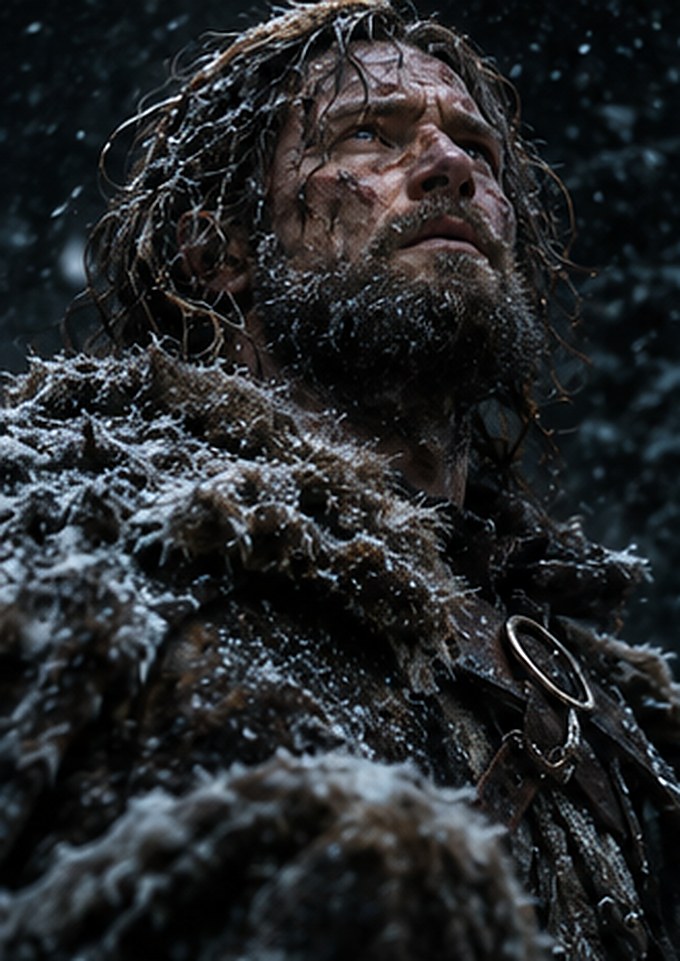
They call me Frost-Hand in Kvenheim, though they keep it downwind, behind the hand, where a man my size will not hear it and come across the fire about it. I have gone across the fire about it more than once. There is a smith two doors down who whistles when he talks now, through the gap I put in his teeth the winter he used the name to my face, and I never told him sorry and I will not start now. The hard years up here make a man hard or they put him under the stones, and I am not under the stones yet. Take from that what ye like.
I earned it at twelve, on the river, the year of the bad thaw. My brother Tor went through the ice ahead of me, and the black water took him down the way it takes everything, slow, and with nothing behind it at all. I went in after him. I got a fist in his coat and I held, and the cold came up my right arm and into the bone and it stayed there. By the time I had him on the bank the boy was blue and still and already gone from behind his eyes, and my hand had died on the end of my arm and never once woke again. I have carried it since. Five fingers of cold meat that do not warm at the fire and do not ache except on the hard nights, when they ache with a cold that is not in the air.
Some in the village say the chill went deeper than the hand, that it found my heart on the way through and left a rime there no hearth has thawed. They are nearer the truth than they think, and I let them keep it for a tale. A man with a dead hand learns he can hold it in the fire and smell himself cook and feel not a thing. And a man who has one part of himself gone quiet like that comes to wonder what else might go quiet if he let it, how much of himself he could set down and still call himself a man. I set a good deal down in the feud-years. I did things with this dead hand that a living one would have shaken too hard to do, and I was good at them, better than good.
I rose that morning before the sun, the way I rise every morning, in the turf-and-timber hut on the downwind edge of the village. Elara lay under the furs with her back to the cold wall, and the shape of her under the hides had gone thin over the winters, thinner than a woman her age should be. She gives her share to the child and tells me she has already eaten. She stirred when I laced my boots.
"Ye going out again." Not a question. Her voice came low so as not to wake the girl. "Tora's cough got worse in the night. I heard it turn wet."
I knelt by the pallet where my daughter slept. Tora, I called her, for Tor, over Elara's weeping, the one fight of our marriage I won. A living girl saddled with a drowned boy's name because her father could not bury what he lost and hung it on the nearest warm thing instead. There are mornings I look at her and it is my brother's face I go hunting in hers. She had kicked the hide off one foot in the night, as she has since she could walk, and I drew it back over her. Her breath came and went with a catch in it, a small tearing sound down at the bottom of each pull. I laid my good hand on her brow. Warm, and climbing. A fever that had not yet broken into the deep burn but was headed there, and quick. I have buried a brother and I know the look the living wear when they are deciding whether to stay. The girl had not decided yet. I meant to give her a reason.
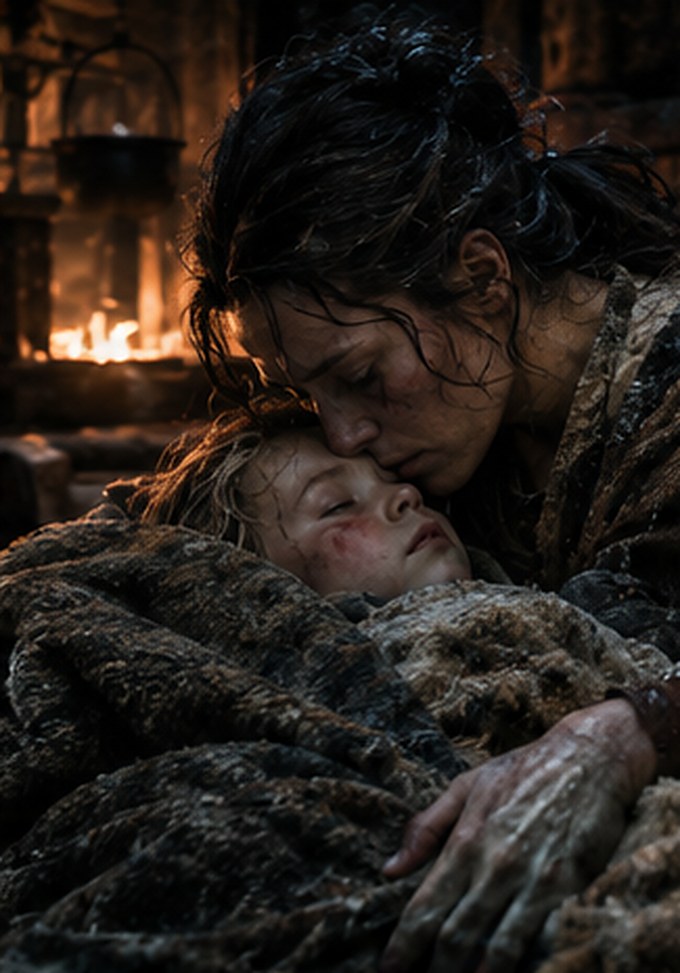
"She'll hold," I said. "There's a south-facing bank two valleys over where the fever-root grows under the snow. I'll bring it back and a hare besides if the snares have been kind."
Elara sat up and the furs slid off her shoulders and she did not reach for them. "Ye say that every dawn, Harrick. There's no giving in the Whitewood. Only taking, and slow, so slow a man does not know the losing until it is done."
"Then I'll take back."
There was more I could have said, and she knew every word of it unsaid, and I gave her none of it, as I have always given her none of it. We call it the North way, the saying of nothing. I have hidden a hard man behind that saying the whole of my marriage, and Elara has let me. I flexed the dead hand inside its leather wrap, and there was the leather and not the fingers under it.
"Cold's an old friend," I said to it, half a jest and half a prayer and the rest of it something I have no word for. "Keeps a man sharp when the soft parts have all gone to rot."
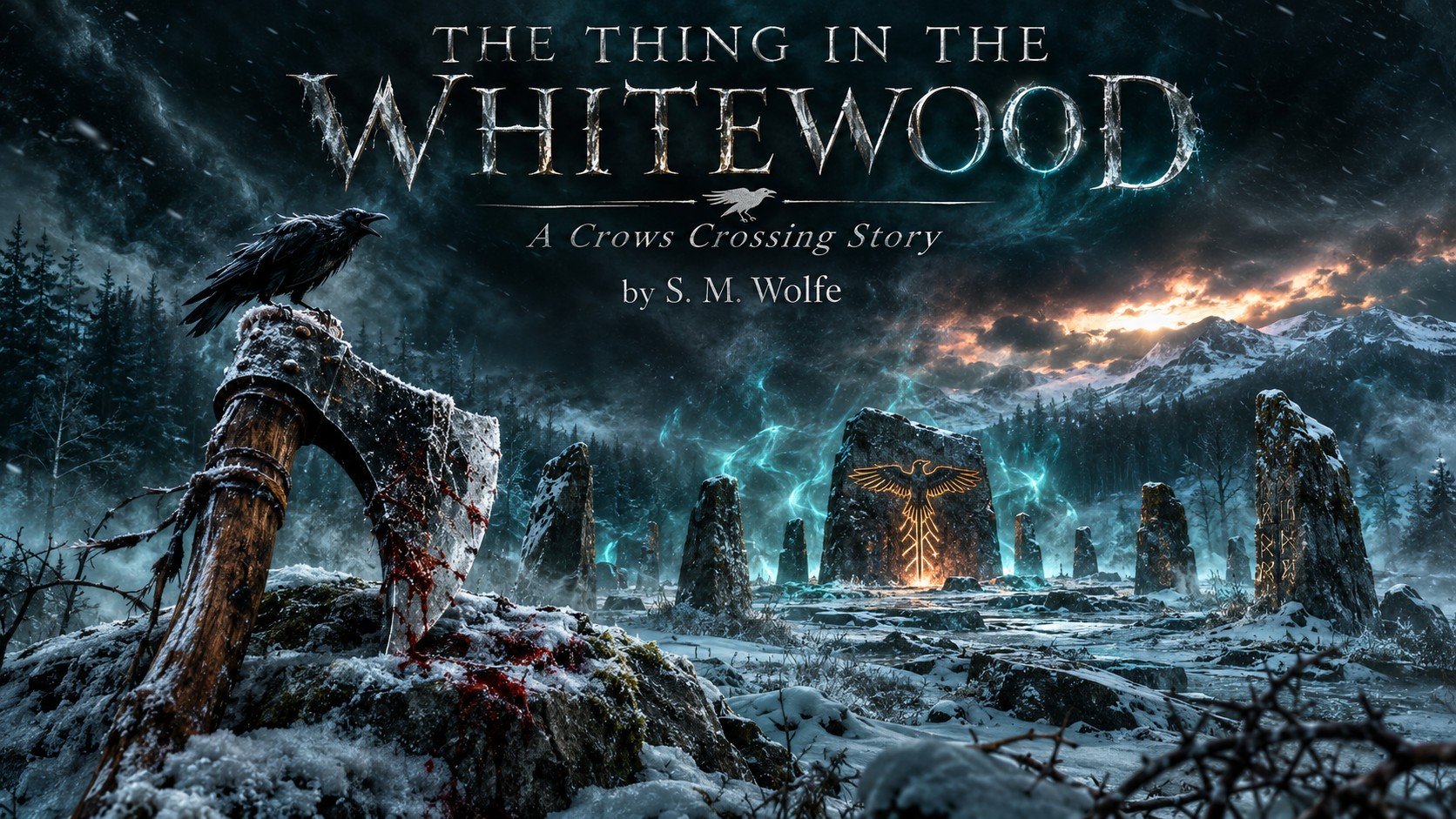
The axe stood by the door where it has stood for generations of Veigrsons, the blade honed down thin and the haft worn to the shape of dead men's grips. I took it up and I went out into a morning gone blue and hard, the stars failing one by one in the east, the Whitewood a black wall of pine and birch beyond the stake-ditch, white with the hoarfrost that never melts off it, winter or no. The folk of Kvenheim take what they can out of it. Game and roots and timber for the long dark. But there are things in those trees worse than the cold, and not all of them are wolves, and the old ones tell of worse still, things that sing a man into a bog or set a whisper in his skull that does not stop until he walks out onto the thin ice to make it stop. I have lived long enough on the edge of those trees to believe the half of it, and I have the scars up both arms to show for the lessons.
Old Gunnar had the gate, leaned on his spear with his breath smoking around his head.
"Hunting again, Frost-Hand. Mind the deep drifts past the Elbow. One swallowed the Haaround boy a few days back and spat his cap up later with naught else in it."
"The wood can try me." I went past him into the trees. "I've the cold on my side and it has never yet lost."
The Whitewood closes over a man the moment the village is at his back. The trunks lean in, black and twisted with age, the frost on them furred thick enough to break off in your fingers. The snow between deadens sound, so that your own breath and the creak of the cold timber become the whole of the world.
The crows came with me. They came the way they always do, black shapes dropping tree to tree a little ahead, watching me with their heads turned, calling down a sound that has always put me in mind of old women laughing at a thing they will not explain. We have a saying up here, that the crows know the roads between one place and the next, the roads a living man cannot see, and that where the crows cross you had best not follow. I had never given it more weight than any other old saying. I had never had cause to.
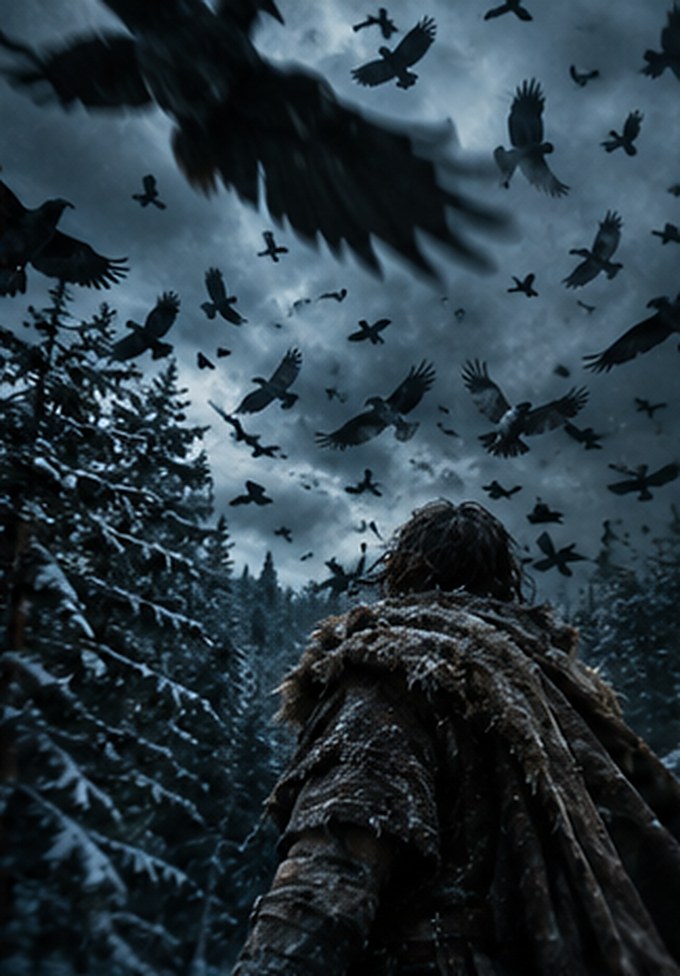
"Ye lot know something I don't," I said to them. "Spit it, then. Or shut your beaks and let a man work."
They did not spit it. But three valleys in, where the birches thin and the land folds down into a cup the old maps do not name, they shut their beaks all at once, every crow in the wood, and they rose off the trees in one black sheet and went south and did not come back. And the quiet they left behind was wrong, the quiet of a wood with something gone out of it.
I should have turned there. A Veigrson never does the sensible thing, and that stubbornness cost me a brother and a hand and it was about to cost me more, and I had never learned to turn around.
I found the ring of birches first. A wide circle of them, and inside it the snow had gone, and the grass under it, every blade browned and curled and crisp with a frost that caught the low light and threw it back wrong, a shine with blue down in it that no honest ice has ever held. The reek reached me before I reached the center. Blood on iron, and under the blood a smell with no earthly thing behind it, a smell of the long cold between the stars that I had no business knowing and knew anyway, down in the dead of my hand.
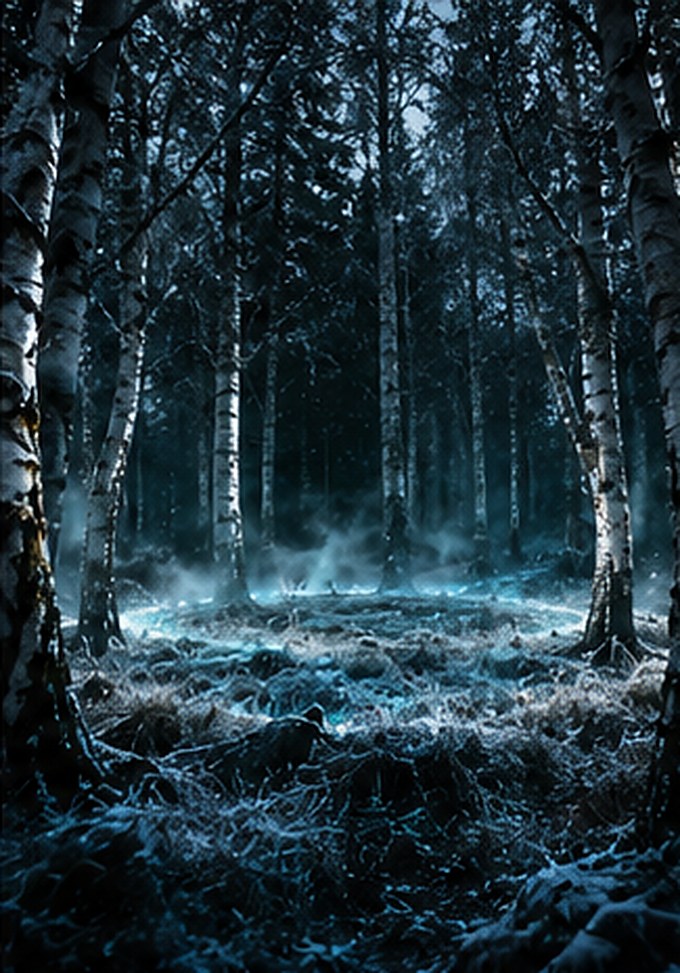
I crouched at the edge of the dead grass and laid the numb hand flat to the ground. The numb hand is the one I use to test a thing that might bite. A jolt went up my arm into the shoulder. Not the clean bite of winter. Something meaner. It went up the arm and kept going past the shoulder, and the dead meat of the hand throbbed for the first time in twenty years.
Then the air in the heart of the ring came apart.
It did not tear so much as thin, the thinning of river ice from underneath before it gives, the black trunks beyond it smearing and doubling, the light between them bleeding into colors that do not belong to any sky I have stood under, blues gone past black, a black with no bottom in it that gave the dawn back no light at all. The thinning widened to a gash the height of a standing man, and its edges flickered with a glow that turned my stomach over on itself, and out of it came the smell of everything cold. And out of it, slow, the thing. It did not step through. It welled up out of the gash and spilled down into the dead ring.
I have fought men. I have fought the big cave bears in their dens with nothing but the axe and a hate for the winter, and I have fought the river itself with my own brother's weight dragging me down into it. I had thought I knew what it was to stand in front of a thing that means to end you.
This was not that.
It came through folded wrong, a shadow first that bent the light around it, then limbs unfolding out of the shadow at angles no spine allows, too many joints, each one opening a way a joint should not open. Along the folds of it, eyes. They slit open sideways down the seams of the dark and looked at me and closed and opened somewhere else, and there was no sense behind them, no beast's hunger I could read and answer, only a pull, a dragging at the middle of my chest, at the thing under the breastbone that a man cannot name and cannot afford to lose. The body of it was black with no bottom to the black, veined through with that drowned blue, and the blue slid under the surface, slow and certain, feeding.
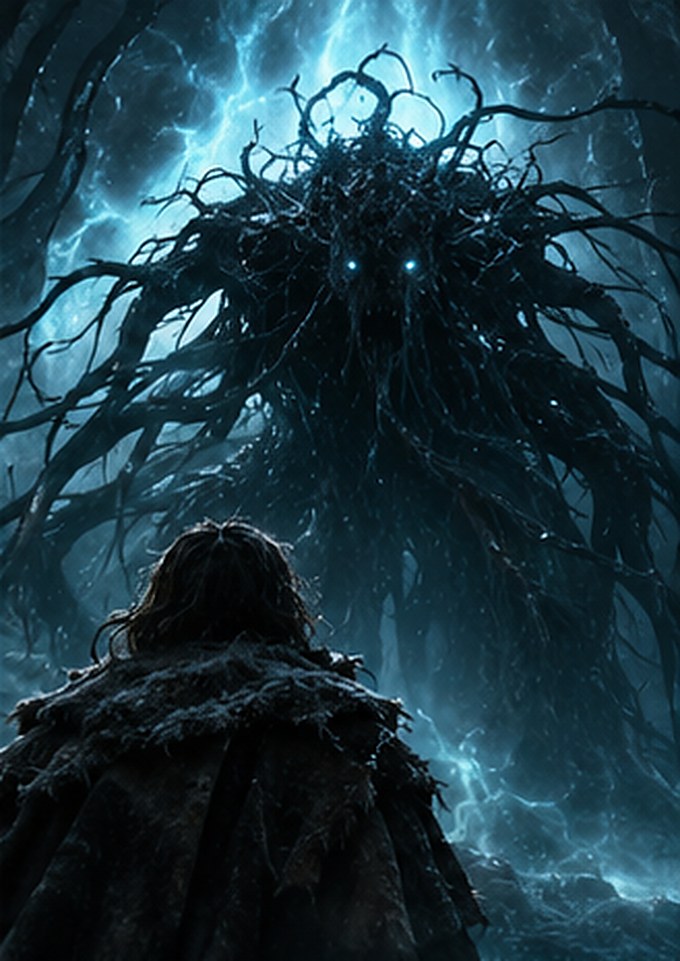
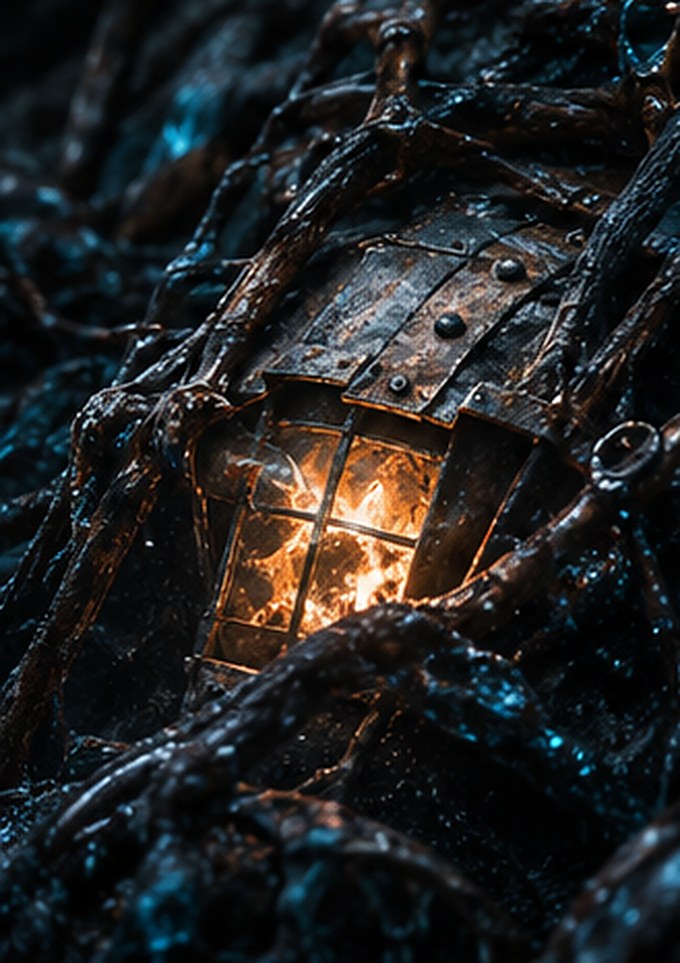
And here is the part I have told no one, the part I could not make Elara believe and gave up trying. Set deep in the shifting black of it there was a plate of burned hide that was not hide. Curved, and pocked along one edge with the holes where rivets had been torn out, and scorched down one whole face to a char. It sat deep inside the churn of it, something the dark had closed over long ago and never worked back out. And low on the front of it, where on a man the heart would sit, one point of light held steady in all that churning. Blue now, and drowned down with the rest of it. But I have warmed my hands at enough dying fires to know a coal that has gone out from one that has gone cold, and that light had not always been blue. It had been a warmer color once. Amber, maybe, the gold of a lamp seen through a frosted pane. Someone had lit it, long ago, and meant it to stay lit, and something had drowned it.
One of the great ruined limbs ended in a hook of fused dark, as though it had once held a thing made to shield and that thing had been melted down into the holding of it. And the whole of the creature, when it turned the eyeless front of it full on me, gave off under the reek and the cold a thin note of something I can only call grief, old, and gone sour, and long since put to work. This was the part I was slowest to understand. It was not blind in its reaching. It reached into me with the sureness of a hand going into a snare it has set and sprung over and over, knowing already the shape of what it would close on. It had done this before. Somewhere down in the ash of what it had lost it had found a use for the losing, and the use was warmth, and over a long time it had grown patient at the taking, and good at it.
It opened a mouth it did not have and spoke a pressure instead of a sound, and the pressure shoved the breath back down my throat, and under the pressure, buried in it, there was almost a word. A name. It was trying to say a name and only the dark between the worlds came out.
Then it showed me Tor.
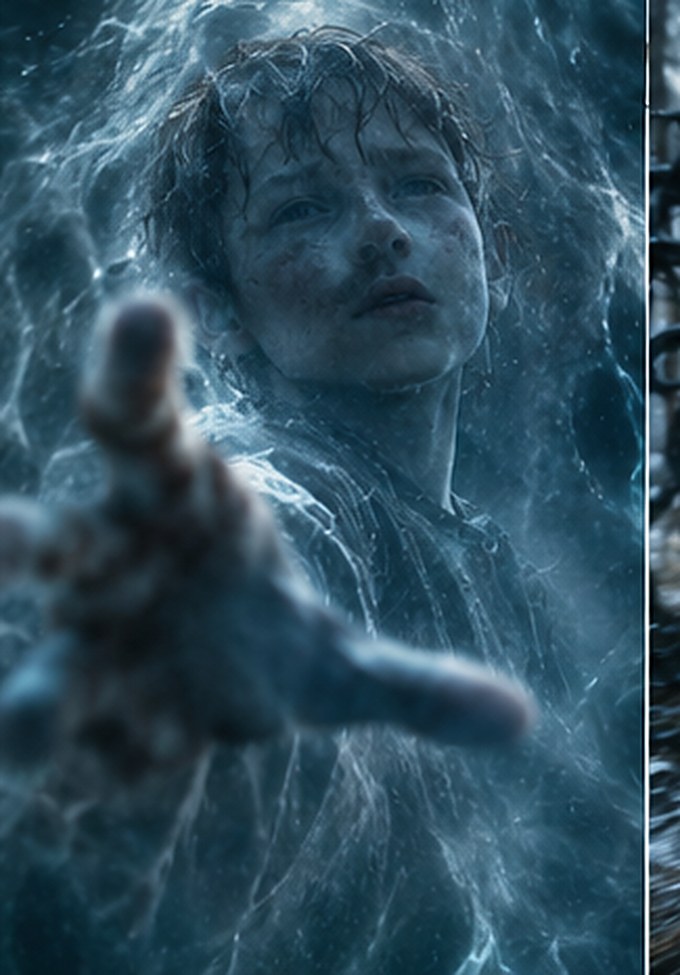
I want to be plain about this. It is the thing that matters and the thing I least want to set down. It reached into the cold meat of my hand, into the oldest wound I own, and it found my brother there where I have kept him these twenty years, and it gave him back to me, whole, no trick at the edge of the eye but Tor himself, twelve years old, on the far side of that gash in the air, his coat still wet from the river and his hair frozen in points and his face turned up to me the way it was turned up to me under the ice in the half second before the current took him down, when he still thought I would hold on. And a knowing came with it, poured straight into me without words, and it was not a plea. It was a kindness, held out plain and sure. Come out of the cold. You have carried him so long and so far that your arm has died of it, and you are tired, and I can take the weight now. He is only on the other side. I have brought so many of them home. Set the hand down. Come and be warm, and be carried, and the two of you can rest.
God help me, I took a step toward it.
And the thing was glad. The gladness came off it plain, the drowned light at its heart warming a half-shade toward the amber it had been, the whole reaching churn of it going still and satisfied for the space of that one step, the stillness of a thing doing again the work it was made for.
I took a step toward the thing that had emptied a wood of crows. It wore my dead brother's face.
It was the dead hand that saved me.
What came reaching out of that gash touched the cold already in my right arm, the old frost, Tor's frost, the part of me that died with him on the bank, and the two colds were one and the same, and nothing of it reached me, no pull, no warm thing under my breastbone for it to drag at. The dead hand had no spark in it for the thing to catch, and in the half breath that it touched that deadness and came up empty, the grief-note in the creature faltered, and the face of my brother flickered.
I turned and I ran.
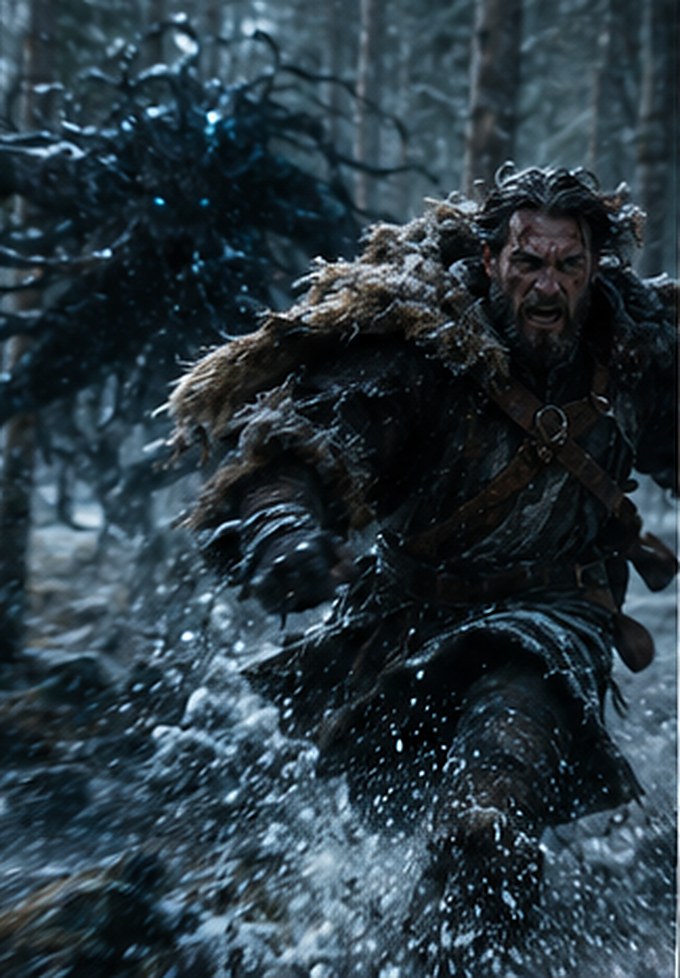
The thing came after me and it did not run. Running is a thing a body does, and whatever that was had left the rules of bodies on the far side of the gash. It flowed. It poured itself over the snow and through the black trunks, part of it always a little ahead of the rest, flung forward into the trees, shadow with no fire behind it to throw it. The saplings in its path did not bend. They went black and brittle and came apart, and where the bark touched it the blue veins flared up bright and fed.
I ran on everything a life in these trees had put in my legs, my eyes already ahead and my feet finding the hard ground under the soft, and I called up every mean trick I had been forced to learn in them. Mean tricks were all I had. I have no magic. I have an axe my grandfather's grandfather swung and a hand that cannot feel and a head full of the wood.
The bear-fall first. In the gully past the Elbow I had rigged a deadfall for the cave bears, a stack of trimmed logs held up on a trigger of twisted withy, enough weight in it to break the spine of anything that walks. I ran the lip of the gully and I hit the trigger-stone with my heel going over, and the whole stack came down behind me in a crack and a roar of splitting pine. For one breath there was silence under it.
Then the pile heaved. Blue light leaked up through the cracks between the logs, and the thing poured out from under a weight that should have ended a bear, its form squeezing thin to come through a gap and swelling fat again on the far side, and a limb lashed out of it faster than the rest and caught me across the back of the calf. The cold of it went through the leather and through the meat, and my stomach turned itself over and I ran on spewing thin bile down my own front, the leg below the knee gone to the same dead nothing as my hand. I ran on three-quarters of a leg after that, the numb foot slapping down without feeling. It was not trying to kill me quick, only spreading its cold into me a touch at a time, deadening me piece by piece, and I did not know yet whether that was mercy or method, whether the dead parts of me were being spared or just saved for later.
"Ye think that's pain," I said to it. A man alone in the dark has to hear a voice, and his own is the only one on offer. "I've worn worse than that to breakfast every morning of my life."
I led it to the brambles next, the great tangle on the north slope where the thorns grow long and black and I have crawled a low run through them after hares since I was a boy. I went down into the run on my belly, the thorns opening old lines across my shoulders, and the thing followed me in because it was fixed on me now and would not be shaken, and the thorns that are nothing to a hare and nothing to a man who knows the run were not nothing to it. The black wood of them snagged its flesh and the flesh did not tear so much as part, and where it parted the blue ichor welled and hissed on the snow and froze black. It made the pressure-sound again, and this time there was something in the pressure that in a living throat would have been rage, and I crawled out the far side grinning with my face full of my own blood and told it the Whitewood had thorns enough for the both of us.
I broke my trail on a long shelf of bare rock, doubled back, kicked snow over my own prints, went up and over a boulder and dropped down the blind side of it and lay still with the dead hand clamped over my own mouth to stop my breath from steaming up over the stone and giving me away. And the thing paused. The pressure in my skull went searching, patting over the inside of my head, hunting the shape of my fear, the heat of my thinking. The dead hand over my mouth gave it nothing. Behind the dead hand I thought of snow. I thought of the white nothing, of cold, of the dead river in winter with no one under it, and I hid the warm part of myself behind the cold part the way I have done it my whole life. I learned that trick not on the river with Tor but three winters after, on a Haaround steading in the black of a reprisal night, a torch in my living hand and the cold already running the dead one, and a man on his knees in the straw with his axe thrown down and his hands open, saying the word mercy, and me going cold all the way through and giving him none. I put that same cold on now, and the searching slid over me and moved on.
I should have lived through the day on that trick alone. But the thing had been learning the wood the whole while it hunted me, the way I once learned it, and it had learned faster. It did not cast about where I had broken my trail. It folded. The air off to my left creased and it stepped out of the crease a body-length from me, and a limb took me in the side before I was off the rock, and I heard my own ribs go, a wet crack down low, and I bit through the edge of my tongue and my mouth filled with the iron of my own blood, and somewhere in all of it my body gave up what it was holding and the warm ran down my leg, and I had no attention to spare for the shame of it. I came up swinging on instinct and the old axe bit into the thing and passed through it, parting it, finding nothing in there to stop on, and the halves closed back over the steel and the cold ran up the haft into my good hand and numbed the fingers to the bone.
I ran again. I had no plan left but to run, and under the running I had one clear thought and could not shake it loose. Kvenheim was close. Over the next rise and down, the peat-smoke would be showing. Elara was there, and the girl with the fever, and old Gunnar with a spear that would not slow that thing by a single breath. If I crested that rise with the thing on my heels I would be leading it home to the two people the whole of my miserable life has been built to keep alive.
I turned away from the smoke. I turned east, toward the standing stones, and I put the last of what my legs had into it.
The stones stand on the bald hill the clans will not build on or graze, and will not name after dark. A ring of them, grey and leaning, older than the Veigrsons and King Ulf and the Named who warred with him, older than the clans themselves and the Berserkers the skalds still sing of. The faces of them are cut with marks no living hand can read, lines and angles and a thing that is almost a crow with its wings thrown wide. The old ones say the stones ward off the walkers from the other side. The old ones also say the stones call them. I had believed neither that morning. Standing in the ring with the thing a half-stride back and its blue light throwing my shadow out long across the snow in front of my feet, I believed all of it.
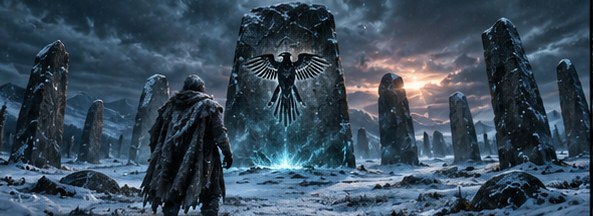
I went into the ring and the air inside it changed, gone thick and charged, the hair standing up along my arms and the back of my neck, a low hum coming up through the soles of my boots and into my teeth and the roots of them. The thing checked at the boundary of the ring. For the first time since it had poured out of the gash, it stopped, and the eyeless front of it swung side to side along the line of the stones and would not come across.
And standing there with my ribs grinding and three limbs gone to dead meat, I had the why of it, why the crows will not fly over this hill. The stones are a door, the same as the gash in the ring of birches, the same kind of thin place between one world and the next. But this door the old world left shut, and sealed, and bound with whatever the Named knew before the strangers came up from the south and the sky changed and the long cold fell. The stones are the mouth of a road, and the road runs back where the thing came from, and some part of the drowned creature knew it and would not go back down into it.
The hum of the stones went up the old frost in my dead hand the same as the gash had, but where the thing's cold had reached into me and come up empty, this went up the dead arm and did not stop at the shoulder, and something in me answered it. I put the numb hand flat to the nearest stone. The cold of the granite and the cold of my hand were the one cold. And I knew a thing then, hand to the stone. It came whole and without words, and I have only words to set it down. The thing fed on living warmth. On the spark under the breastbone. It could not take what was already cold and dead, and I had been more than half dead for twenty years and never known the use of it.
Village horns went up behind me, down the hill and getting closer, Gunnar's horn and others, the whole of Kvenheim turning out because someone on the wall had seen the blue light on the bald hill and known it for nothing good. They were coming. They would come into the ring with their spears and their bows and the thing would drink them down and come back wanting more, and I could not have that. I have let a great many things happen in my life that I could not stop. I was not going to let that one.
I did the only thing a man in my place could do. I went back out of the ring, out past the safety of the stones, and I made myself the warm thing in the open, and I called it.
"Here." I put the whole of my chest behind it and my voice came out of me in rags. "Over here, ye void-got, world-ending thing. There's warm meat here and it's done running. Come and take it if ye have the belly left."
It came. God, it came, all that folded black and drowned blue pouring across the snow at me, and it showed me Tor again as it came, closer now, close enough that the water stood beading on my brother's dead lashes, close enough that the knowing of it filled up the whole inside of my skull. And this time, close and sure of me, it was careless, or it did not reckon a dead man's eyes could catch it. Behind my brother, a half breath behind him and gone when I looked straight on, there were others. A boy I did not know with a wool cap too big for his head. A woman with her hair in a widow's knot. A grown man leaning on a drover's switch. The faces it kept. They were not afraid, not one of them. They had the ease of people brought in out of the weather and given a chair by the fire, warm and home and in no hurry to leave. The ones it had walked out onto the ice before me, each one somebody's beloved dead, each one brought home as it meant to bring me. Tor was not mine alone and never had been. He was bait, and it had chosen him for no reason grander than that I was the one fool in the wood still carrying his dead where a cold thing could get a grip on it. Hold on. This time hold on. You let go of me on the bank, brother. You let the cold take your hand and you let them wrap me in linen and put me under the stones and you went on living with that, twenty years of going on living with that. Hold on this time and I will stay. Only hold.
And I wanted it. The horns were in the air behind me and my own people climbing the hill to die for me, and I stood with my brother's face a reach away and they were nothing to me. For three breaths, maybe four, every soul on that hill was less to me than the wet coat of a boy twenty years drowned, and I would have let the thing take them all to get my hand back around it.
And that was the thing's one mistake, if a thing like that can make one. It reached too deep. It pulled up the truth it meant to use on me and did not see that the truth was a door, and that it had opened the door the wrong way.
I did let go of him on the bank. That is the wound. Never that he drowned. That my hand, my living hand, gave out at the last, that the cold got into it and the fingers would not close and my brother's coat slipped through them in the black water, and I have told myself every day for twenty years that it was the cold and not me, and never believed it. I have spent my whole life since refusing to let anything go. The hand that died holding him. The girl I gave his name. I have never once let go of anything.
The thing in front of me was the same, the shape of it plain now under the horror. It had been made to carry the weak out of the cold, and it had lost the one it carried, and it could not let go, and the not-letting-go had hollowed it out until all that was left was the reaching, the terrible reaching down a line to a hand that was ash on the other side of the world. I was made for less, only to pull one boy out of one river, and I had failed even at that, and I had spent the twenty years since learning to take instead. It was me, further down the same road, and colder.
So I did the one thing I have never done. The thing I have spent a dead hand and a ruined life learning that I could not do.
I let go.
I let go of Tor. I stood in the snow with the thing a breath away from me and I looked at my brother's dead face wearing that lie of a smile and I said the thing out loud that I have never let myself say, not in prayer, not drunk, not with Elara's arms around me in the dark. I said, "Ye're gone, Tor. Ye've been gone twenty years and I cannot bring ye back, and I have to stop trying before it takes the rest of me as it took this thing. I let go of ye on the bank. I am letting go again now, on purpose."
And I reached out with the dead hand, the hand that could not feel, the hand that has no warmth in it for the thing to catch, and I took hold of the creature.
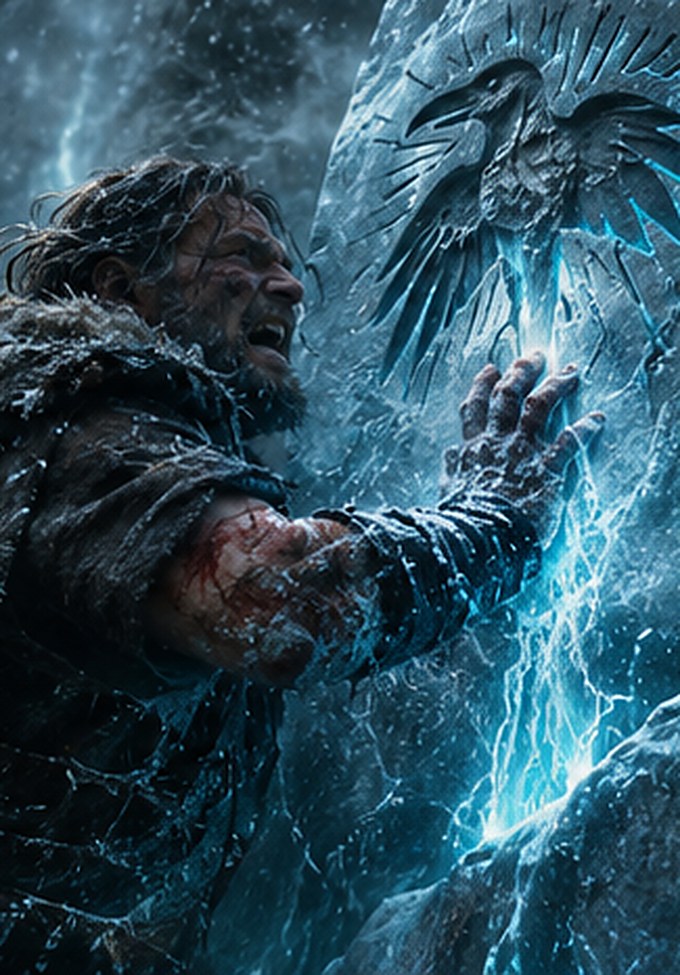
It was the one grip it could not read. It poured its cold into me and there was nothing of me left there to deaden, nothing under that breastbone to drag, only the old frost that had sat in my arm since the river, and my cold and its cold were the one cold, and for a moment, holding it, I was as dead as it was, and it could not tell where it ended and I began. I turned, with my dead fist full of the writhing dark, and I walked it backward into the ring of stones, into the door the old world had sealed, and I set my boots over the carved crow on the threshold stone and I put the whole of my dead weight into the holding.
The thing screamed then, and the scream was a name, the name it had been trying to say since it came through the gash, and all at once the stones came alight. Blue fire and a light with no color poured up out of the carved ring and the thing came apart in my grip, its drowned blue bleeding away into the seal, its too-many eyes winking shut one after another down the length of it, the burned plate of hide that rode inside it glowing white and then dark, the one steady light at its heart guttering out for good, and it was certain to the last, the knowing still coming off it, come and be warm, come and be carried, gone in the middle of the word. And in the last of it, the very last, as the reaching thing and the reaching part of me stood there as one dead cold held against an older cold, it let go too, and not of me. It let go of the one it had been reaching for all this time, the hand on the far side that was never going to close. And it stopped.
The light took everything. Cold and noise and a white with nothing in it.
Then nothing at all.
I woke to the crows. They had come back, a whole black council of them on the leaning stones, calling down that old-woman laugh, and the snow was falling soft and slow and filling in the ring, filling the black scar in the center where the thing had been, filling the prints of my own boots. My axe lay beside me with the blade warped out of true and the haft split end to end, generations of Veigrson grips broken in a single night, and I have not had the heart to burn it or the heart to mend it, and it hangs over my door to this day.
My right arm was dead to the elbow. The hand had gone the color of a three-day corpse and the fingers had drawn in toward the palm and set there, curled under and gone hard, and they have never opened since. The leg below the knee I drag a little now when the weather turns. More of me had gone dead. The cold goes deeper every time I use it, and I have stopped pretending there is any other road through. I would walk it again this morning if it came to it.
The village was all around the stones by then, spears lowered, faces grey. Elara came through them on her knees in the snow and got her arms around my ruined side and did not care that I cried out, and Gunnar stood over the both of us leaning on his spear and could not find a word, old Gunnar who has always had a word.
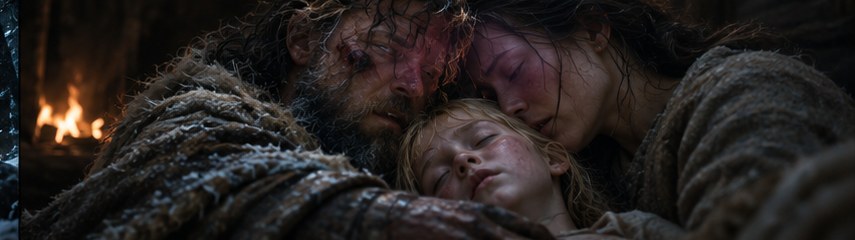
"Harrick," Elara said into my neck. "Ye fool. What in the dead's name was it."
"Something that came through a crack in the world." It was all the truth I had the breath for. "It wanted what I had. The woods said no."
Gunnar found his word at last. He put his hand on my dead shoulder, careful, as though he was not sure I was all the way back yet. "Ye saved the whole of us, Frost-Hand. Every soul on the wall."
"Saved myself," I said. "The rest was luck and old stones."
They half carried me down off the hill, and I let them, and the whole walk down I listened to the inside of my own skull and heard what I had not had the courage to tell them. The reaching had not left me when the thing died. It had left a thread of itself in the cold of me, a thin cold line running out of my dead hand and off the edge of the world, and at the far end of it, faint, so faint I could call it fancy and half do, something waited. Most nights I tell myself it is Tor, and most nights I believe it. But I held that creature long enough to learn where it began, and it began on a bank with a brother going down and a hand already dead. The reaching is in me now. I let my brother go in the ring and meant it, and still the line did not close, and I have woken in the dark with the dead hand lifted toward it and no memory of raising it. I no longer know whether the thing at the far end is my brother or the first cold inch of what I will come to, and I have stopped being certain the two are different. The dead are not gone. The northern folk have always half known it, and the southern folk, I hear, are only starting to. I carry the knowing as I carry the hand, and the axe that will not mend.
When they brought me in out of the cold, the fever had broken in my daughter sometime in the night I was gone. Elara did not know the hour of it. She had been on the wall with her bow, watching the blue light on the hill, sure she was watching her husband die, and when she came back down to the hut the girl was sleeping easy with the sweat dried on her and her breath come clean. The fever-root was still two valleys over under the snow where it grows. I never reached it. I never dug a single thread of the thing I went out to find. The child lived anyway, on her own, as the living sometimes do, while I was off on a bald hill learning how to let the dead be dead.
I sat down by her pallet with my good hand, the only warm hand I have left. The fever was gone out of her brow, broke on its own in the dark while I was off failing to bring home the cure for it. I laid the warm hand there and left it, which is a thing I have not done since she was small enough to carry, and I looked at her a long while and did not once go hunting my brother's face in hers. She slept on under it, her breath going in and out without the tearing in it, small and even and alive. In her sleep she turned toward me and her hand came out from under the hide and found the dead one where it lay, and her fingers closed around the fingers that will not close, and none of it reached me. I left it where it was and let her hold it. The cold line ran out of that same hand and off the edge of the world into the dark where my brother is, so that she had hold of the one part of me that reaches for the dead, and did not know it, and I did not take it from her. I did not tell the cold it was an old friend, and I did not wake Elara in the next room to say any of the soft things too late to say. I kept the good hand on her brow, a cold man doing the one warm thing left in him, badly, until the grey came up full and there was wood to split. Then I got up, and I went, and I split it.
Fin